Key takeaways
- Outbound sales means you start the conversation. You pick the accounts, you make first contact, and nothing happens until you do.
- The arithmetic decides whether it works. A fully loaded in-house rep costs roughly $1,100 per qualified meeting at median output, and almost no guide on this topic will tell you that.
- The gap between average and good is enormous. Average reps connect on 5.4% of cold calls and top-quartile reps on 13.3%, from the same dial counts.
- One contact per company is the most common structural mistake. The typical B2B buying group is 11 people, and 16 on deals between $700K and $1M.
- Outbound is wrong for some businesses. If your deal size cannot fund about $1,100 per meeting, or your total market is small enough to burn through in a quarter, do something else.
In This Post
- What is outbound sales?
- Outbound sales vs inbound sales
- The outbound sales process, step by step
- Who does the outbound work: SDR, agency, or AI
- What outbound sales actually costs per meeting
- The Cost-Per-Meeting Gate
- What the outbound sales benchmarks really say
- How many people to contact at one account
- What to expect in your first 90 days
- Outbound sales metrics that matter
- Is cold outbound legal?
- When to skip outbound sales entirely
- How Cronical fits
- Methodology
- Frequently asked questions
- Related reading
What is outbound sales?
Outbound sales is any motion where you initiate contact with a company that has not asked to hear from you. You choose the target accounts, you find the people inside them, and you reach out first by phone, email, LinkedIn, or all three. Inbound is the mirror image: the buyer raises their hand and you respond.
That definition is where most articles on this keyword stop being useful. They will give you the same five-step process, the same SDR org chart, and the same list of best practices, then leave you with no way to answer the only question that matters when you are deciding whether to build this. Does it pay?
So this guide covers the process, and then it covers the numbers: what a meeting costs, what output looks like at median and at the top, how long before anything lands, and the conditions under which you should not run outbound at all.
Outbound sales vs inbound sales
The honest version of this comparison is shorter than the ones you have read, because for most companies reading it, the choice is not actually available. Inbound requires an audience. If you have no traffic, no list, and no brand recall, inbound is not a strategy you picked over outbound. It is a thing you do not have yet.
| Outbound | Inbound | |
|---|---|---|
| Who moves first | You do | The buyer does |
| Control over targeting | Total. You pick the account list | None. You get who arrives |
| Time to first conversation | Days | Months, after the content compounds |
| Cost shape | Mostly labor, paid monthly | Mostly upfront, paid down over time |
| Scales by | Adding capacity and coverage | Adding audience |
| Fails when | Targeting is wrong | Nobody knows you exist |
The practical read: outbound buys you control and speed at a per-meeting price. Inbound buys you cheaper meetings later, in exchange for time you may not have. Most teams under $5M run outbound because it is the only lever that works this quarter, then build inbound behind it.
The outbound sales process, step by step
Five steps, and the order is load-bearing. Nearly every failed outbound program I have seen skipped straight to step three.
- Define the account list, not the lead list. Decide which companies could realistically buy, using firmographics you can verify and a trigger that suggests timing. A list of 300 correct companies beats 3,000 plausible ones.
- Find and verify the people. Get real names and real contact data for several roles inside each account. Bad data does not just waste sends, it damages the sending domain you need for everything after.
- Run a sequence across more than one channel. Email carries volume, calls carry conviction, LinkedIn carries social proof. Gong's analysis of over 300 million calls found email reply rates of 1.81% without cold calls and 3.44% with them, which is the clearest argument against running a single channel.
- Qualify hard and early. A meeting that will never buy costs an AE the same hour as one that will.
- Hand off or close. Whoever runs the first call, the handoff is where most booked meetings quietly die.
Everything past step one is execution. Step one is where the economics are decided, which is why the cost section below matters more than any subject-line advice.
Who does the outbound work: SDR, agency, or AI
Four routes, and the honest differences between them are cost shape and how quickly you find out you were wrong.
| Founder or AE does it | In-house SDR | Agency | AI execution layer | |
|---|---|---|---|---|
| Cost shape | Your time, unpriced | $80K OTE plus overhead | Retainer, often plus a per-meeting fee | Software subscription |
| Time to first meeting | Days | Weeks, after a 3 month ramp | Weeks, after onboarding | Days |
| Realistic output | Low but high quality | About 8 to 10 meetings a month | Contracted, quality varies | High volume, quality follows the targeting |
| Main failure mode | You stop when sales gets busy | Attrition and ramp cost | Generic messaging on your brand | Volume without judgment |
| Best when | Pre product-market fit | Repeatable motion, funded | You need capacity, not learning | The motion is known and worth repeating |
The in-house route is the default, and it is the one people budget worst. The Bridge Group's 2025 study of 351 B2B companies puts median SDR on-target earnings at $80,000, split $55,000 base and $25,000 variable. That is before payroll tax, benefits, tooling, data, and the manager's time.
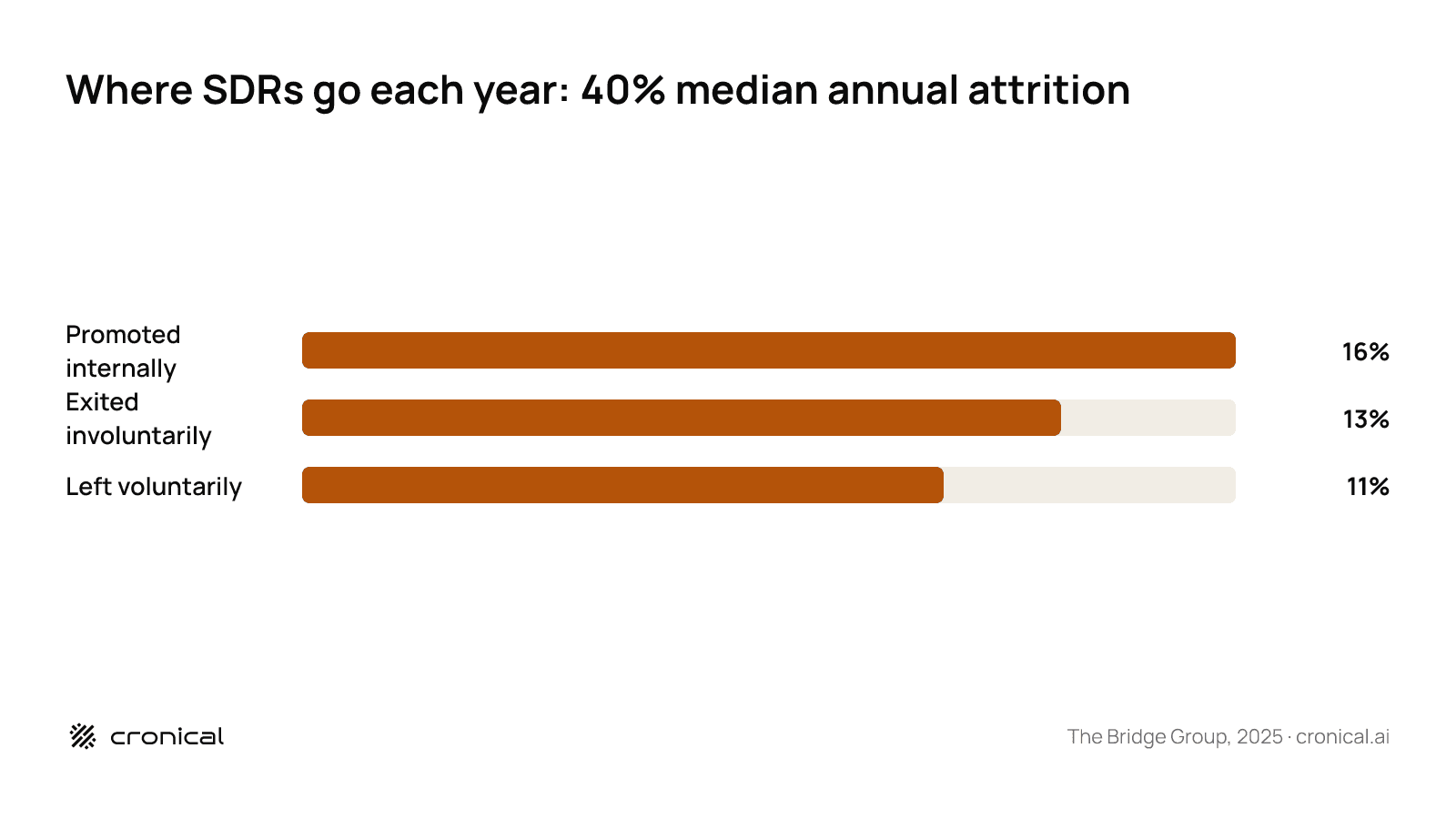
Then there is the churn. Median annual SDR attrition runs at 40%, made up of 13% involuntary exits, 11% voluntary departures, and 16% internal promotions. Median tenure in the seat is 1.9 years, and ramp to productivity takes 3.0 months. In practice you are re-paying the ramp cost on nearly half your bench every year.
What outbound sales actually costs per meeting
Here is the arithmetic nobody publishes. It is not complicated, which makes its absence from every ranking article on this topic harder to explain.
Take one in-house SDR. Median OTE of $80,000 becomes roughly $100,000 fully loaded once you add payroll tax and benefits at a conservative 25%. Add data and tooling at about $6,000 a year. Call it $106,000 in annual cost.
Now the output. Median quota is 10 introductory meetings a month, and only 60% of SDRs hit quota, the lowest attainment on record in that study. A median rep therefore lands somewhere near 8 a month, or about 96 a year.
$106,000 divided by 96 meetings is roughly $1,100 per qualified meeting. Hit full quota every month and it falls to about $880. Include the three month ramp in year one and it rises past $1,400.
That number is the whole decision. If a meeting is worth more than $1,100 to you, outbound is a machine that turns money into pipeline. If it is worth less, no amount of subject-line optimization will save the program, because the arithmetic was wrong before the first email went out.
The Cost-Per-Meeting Gate
Run this before you hire anyone, buy anything, or write a sequence. It is four steps and the order matters, because each step invalidates the next one if it fails.
The framework
The Cost-Per-Meeting Gate
- 01
Price a meeting
Average contract value multiplied by your win rate, divided by the number of meetings it takes to close one deal. That is what a single qualified meeting is worth to you. Most teams have never calculated it.
- 02
Price your motion
Fully loaded monthly cost divided by meetings actually booked last month. Include tooling, data, and the ramp you are still paying for. Compare it to step one.
- 03
Open the gate, or stop
If cost per meeting exceeds value per meeting, do not add volume. Volume multiplies the loss. This is the step everyone skips, and it is the reason failed outbound programs get louder before they get cancelled.
- 04
Fix in order: list, coverage, channel, volume
List quality moves the number most. Contacts per account moves it second. Channel mix third. Raw volume moves it least and costs the most. Work the levers in that sequence and stop when the gate opens.
What the outbound sales benchmarks really say
The statistics quoted in most outbound guides are old, vendor-supplied, and undated. You will see the same line about the percentage of buyers who accept meetings from sellers, sourced to a study nobody links, alongside a referral statistic from a 2015 advertising report. Neither tells you anything about your pipeline.
The useful benchmarks are the ones with a sample size and a date attached. Gong analyzed more than 300 million cold calls and found the average rep connects on 5.4% of dials while the top quartile connects on 13.3%. Meeting set rates split the same way, 4.6% against 16.7%.
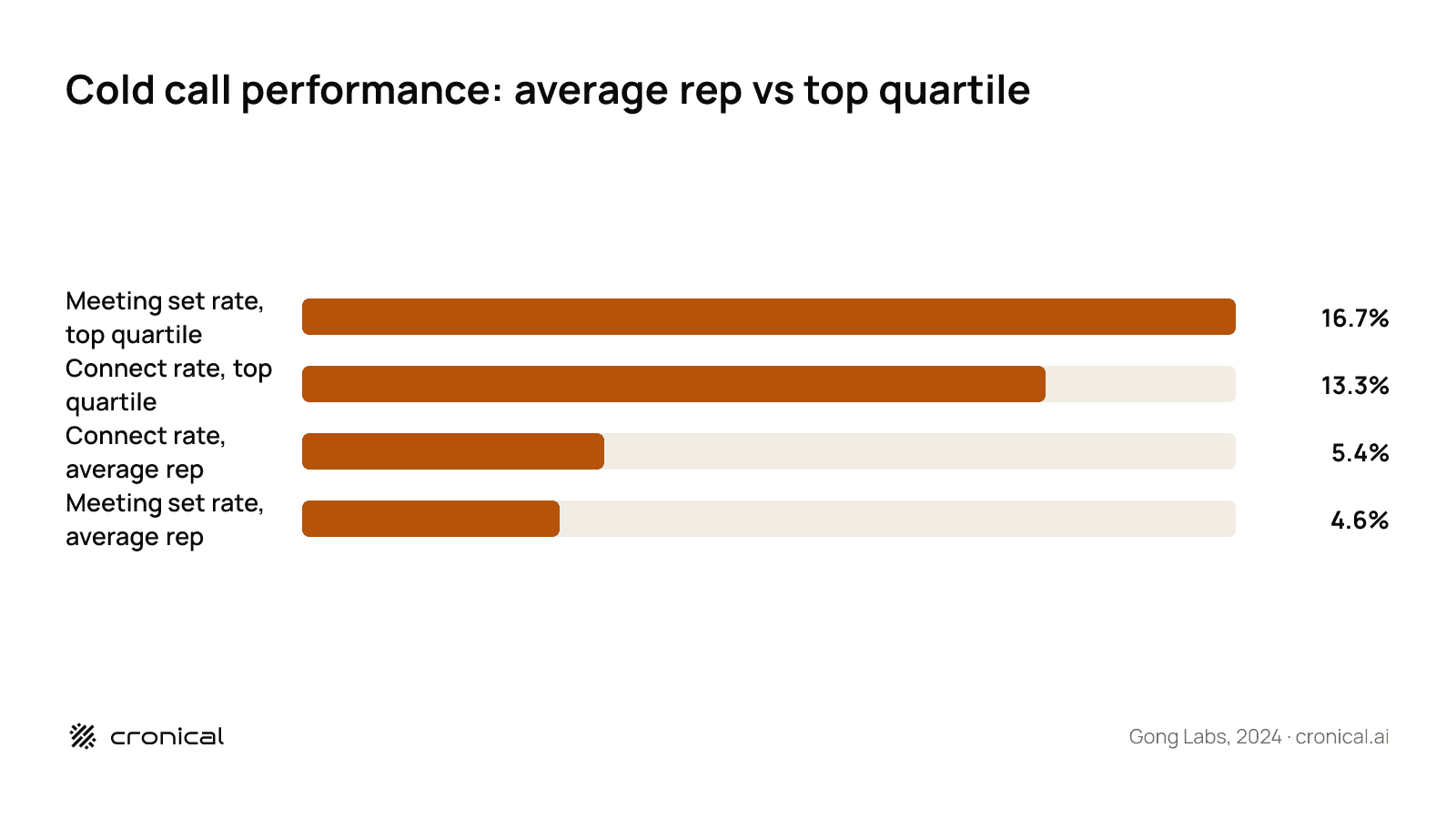
Translated into a month of work, the same study found that 800 dials produce about 2 meetings for an average rep and 18 for a top-quartile rep. Identical effort, nine times the output. It takes 19 dials for an average rep to reach one conversation and 8 for the best.
The wider picture is not comforting either. Ebsta and Pavilion analyzed 4.2 million opportunities across 530 companies and found sales cycles 38% longer than 2021, 69% of reps missing quota, and rep turnover climbing from 22% to 36%. Their sharpest finding: 17% of reps generate 81% of revenue.
Read those two datasets together and the conclusion is uncomfortable but actionable. Outbound still works, and the median outbound operator is not the one it works for. The distribution is what you are fighting, not the channel.
How many people to contact at one account
This is the structural error in almost every outbound program, and it is invisible because every guide teaches it. The unit of work is treated as the lead. One person, one company, one sequence, one reply rate.
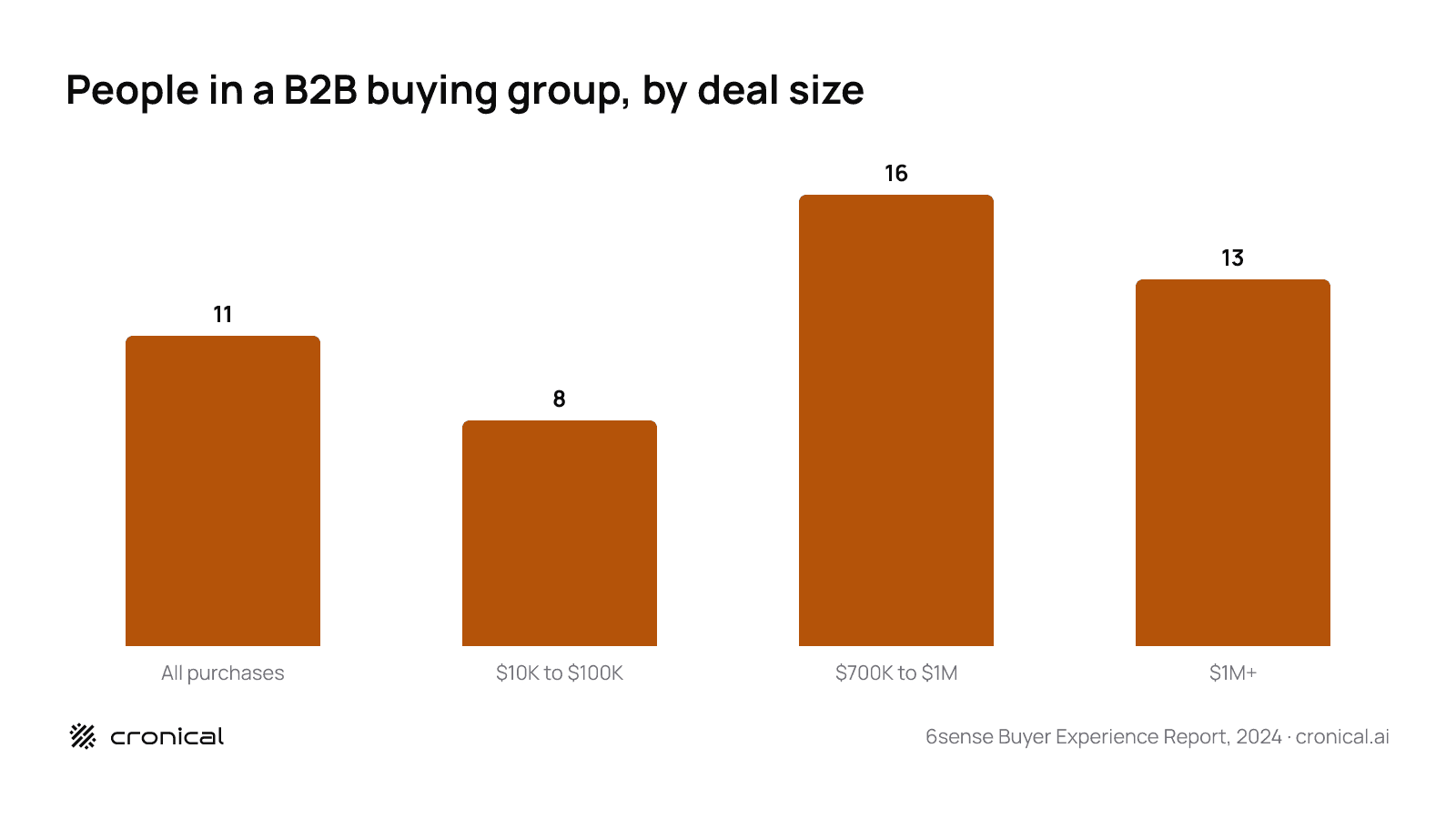
That is not how B2B purchases happen. 6sense surveyed 2,509 recent B2B buyers and found the typical buying group runs to 11 people, rising to 16 on deals between $700,000 and $1M.
Worse for the single-threaded rep, the same research found buyers complete 69% of their purchase process before they engage a seller, and 81% already have a preferred vendor by the time they make first contact. Kerry Cunningham, who runs research at 6sense, draws the obvious conclusion for anyone waiting to be contacted.
To compete effectively, marketers must drive awareness and preference early in the buying journey.
The fix is not more volume. It is more coverage per account: three to five relevant people at each target company rather than one, with messages that reflect what each of them actually owns. The buying committee guide covers who those people usually are, and account-based outreach covers how to sequence them without sounding like a broadcast.
What to expect in your first 90 days
No article on this topic attaches a calendar to the process, so people benchmark themselves against an imagined instant result and quit in week four.
Weeks 1 to 3. Domain and inbox warmup, list build, message drafting. Very low volume on purpose. Gmail requires bulk senders to keep spam complaints below 0.1% and never at or above 0.3%, and a cold domain pushed hard fails that test permanently.
Weeks 4 to 8. First real volume. Expect replies before you expect meetings, and expect most replies to be negative. This is the stretch where programs get killed. The Bridge Group's ramp figure of 3.0 months exists for a reason, and it applies to a trained rep with an existing playbook, not to you inventing one.
Weeks 9 to 13. First patterns worth acting on. You will have enough replies to see which segment answers and which message lands. Now you can compute cost per meeting honestly and run the gate above.
If you need pipeline faster than that, outbound is not the wrong channel, but a cold start is the wrong plan. Start with the accounts where you already have some signal or relationship.
Outbound sales metrics that matter
Most outbound dashboards measure activity because activity is easy to count. Four numbers actually govern the program.
- Cost per qualified meeting. The gate. Everything else is an input to this.
- Account coverage. The share of your target list where you have reached three or more relevant people. This is the metric that exposes single-threading, and it is the one almost nobody tracks.
- Meeting-to-opportunity rate. Catches the failure where volume goes up and quality collapses.
- Time from first touch to first meeting. Your feedback loop. If it is 60 days, you get six learning cycles a year.
Reply rate belongs on the list only as a diagnostic. It moves with subject lines and list quality, and a team can improve reply rate while booking fewer meetings.
Is cold outbound legal?
Every guide on this keyword skips this, and it is the one section with real downside. This is not legal advice, but three questions cover most of the exposure.
Do you have a lawful basis for the data? In the EU and UK, GDPR requires one. For B2B outreach the usual basis is legitimate interest, and Recital 47 states that "the processing of personal data for direct marketing purposes may be regarded as carried out for a legitimate interest". That is a real basis, not a loophole, and it requires you to document the assessment and honor objections.
Is the message compliant where it lands? In the US, CAN-SPAM permits cold commercial email without prior consent, but requires accurate headers, a non-deceptive subject line, a valid physical postal address, and a working opt-out you honor promptly. Each violating email is separately liable.
Can you prove it later? Keep the source of every record, the date, and the opt-outs. The practical risk in outbound is rarely a regulator. It is an angry recipient with a compliance team and no record on your side.
Rules differ by country, not by campaign
Sole traders and partnerships are frequently treated as individuals rather than businesses under national marketing rules, which changes what you may send them. If you sell across borders, check the rules for the recipient's country, not yours.
When to skip outbound sales entirely
Every article ranking for this keyword is published by a company whose product is outbound, so none of them will write this section. There are four conditions where you should not run it.
Your deal size cannot fund a meeting. If a closed customer is worth $2,000 in lifetime value and a meeting costs $1,100, the model never closes. Sell through a channel, product-led motion, or partners.
Your market is too small to burn. With 300 accounts total, a bad first campaign spends a third of your reachable market on a message you had not tested. Small markets reward slow, researched, personal outreach and punish sequences.
You have nothing to say yet. Outbound converts existing demand and interrupts everything else. Only about 5% of buyers are in market at any given time. John Dawes of the Ehrenberg-Bass Institute, whose work established the ratio, puts the scale of the problem plainly.
up to 95% of people or firms are not in the market for many goods and services at any one time
Nobody will own it. Outbound run in the gaps between other work produces nothing and teaches you nothing, because the volume never reaches significance.
What this means for you
- Calculate what one qualified meeting is worth: ACV times win rate, divided by meetings per closed deal.
- Calculate what one currently costs you: fully loaded monthly spend divided by meetings booked.
- Cut your account list to the companies you can name a reason for, then cut it again.
- Set a coverage target of three or more relevant contacts per target account, and measure it weekly.
- Warm the sending domain before volume, and keep spam complaints under 0.1%.
- Give the program 90 days and one owner before you judge it.
How Cronical fits
Cronical is an AI pipeline generation engine built for the coverage problem described above. Instead of sequencing one contact per company, it works the whole account: it identifies the relevant people across the buying group, researches each one, and runs personalized outreach across email and LinkedIn, so account coverage becomes something you can actually operate rather than an aspiration. That changes the cost arithmetic in this guide, because the expensive part of outbound is the human hour per contact, and coverage is what turns a single-threaded program into a multi-threaded one. If that is the constraint you are hitting, join the waitlist.
Methodology
Frequently asked questions
What is outbound sales in simple terms?
Outbound sales is when you contact a potential customer first, rather than waiting for them to find you. It covers cold calling, cold email, and LinkedIn outreach to companies that have not expressed interest.
What is the difference between outbound sales and cold calling?
Cold calling is one channel inside outbound sales. Outbound is the whole motion: choosing target accounts, finding the right people, and reaching them across calls, email, and social. A team can run outbound without making a single call.
How much does outbound sales cost per meeting?
For an in-house rep, roughly $1,100 per qualified meeting at median output, based on a fully loaded cost near $106,000 a year and about 96 meetings. It falls under $900 at full quota and rises past $1,400 in year one once ramp is included.
Is outbound sales still effective?
Yes, but the distribution is brutal. Top-quartile reps connect on 13.3% of cold calls against 5.4% for average reps, and 17% of reps generate 81% of revenue. The channel works. The median execution of it does not.
How many people should I contact at one company?
Three to five relevant people is a reasonable floor, given that the typical B2B buying group is 11 people and larger on bigger deals. One contact per account is the most common reason a well-run sequence still produces nothing.
How long before outbound sales produces pipeline?
Plan for 90 days: three weeks of warmup and list building, four to five weeks of first volume, then a month of real signal. Trained reps take 3.0 months to ramp with an existing playbook, so a cold start is not faster.
Related reading
- B2B Buying Committees: How to Win the Whole Account
- Account-Based Outreach: Reach the Whole Committee
- B2B Appointment Setting: Services, Costs, and AI
- GTM Strategy Framework: Why You Need 3 Layers, Not 20
- Is Cold Outreach Dead? No, But Spray-and-Pray Is
- Data Enrichment: What It Is and Why It Matters