Key takeaways
- Logistics leads are an outbound game. Freight is a high-volume, cold-outreach business, and the shippers worth winning are rarely the ones who fill in a form.
- The freight brokerage market is brutally top-heavy: the top 3% of brokerages take 80% of gross revenue, so the other 97% fight over what is left and cannot afford wasted outreach.
- A shipper is not one traffic manager. The freight decision runs through logistics, procurement, warehouse operations, and finance, and a logistics sales cycle averages about 117 days.
- Cold calling still works, but blind dialing is punishing. Around 80% of freight cold calls hit voicemail, and it takes five to six dials to reach one prospect.
- Treat the shipper account, not the contact, as the unit of the deal. Target lanes you can cover, map the shipping org, multi-thread it before the RFP, then climb the routing guide.
In This Post
- What logistics lead generation means for freight brokers
- Why cold outreach still runs the freight business
- How freight brokers find shippers: the channels, ranked
- The freight brokerage shakeout: why logistics leads got harder
- Map the shipping org before you generate a single lead
- The freight sales cycle, and why single-threading breaks
- The Routing Guide Ladder: a framework for logistics lead generation
- The freight broker's logistics lead generation playbook
- Inbound marketing for logistics: build the demand engine
- A logistics lead generation checklist
- The bigger picture: a consolidating market rewards account depth
- How Cronical fits logistics leads
- Frequently asked questions
- Related reading
What logistics lead generation means for freight brokers
For most B2B companies, a lead is someone who raised their hand: downloaded the guide, booked the demo, filled in the form. In freight, that definition falls apart. A shipper with real volume already has brokers calling every week. They are not filling in your form. They are picking up a phone when a lane goes sideways, or opening a bid when the contract clock runs out.
So logistics lead generation, for a freight broker, means something more specific than "attract inbound interest." It means finding the companies that ship freight you can actually cover, getting in front of the people who choose the broker, and being present at the moment those people are in the market. The work is mostly outbound, and the prize is a spot in a shipper's routing guide, not a single email reply.
The stakes are large. The total revenue booked by US freight brokerages is estimated at around $160 billion, moving across tens of thousands of brokerages competing for the same shippers. That is a big market, and a crowded one, which is exactly why the brokers who generate logistics leads deliberately beat the ones who dial at random.
Why cold outreach still runs the freight business
Ask ten freight brokers how they landed their first shippers and nine will describe some flavor of cold outreach: a call list, a lane they could cover, a manager who finally picked up. Freight is one of the last big B2B categories where the phone is still the primary lead-generation engine, and that is not nostalgia. Shippers with in-market freight are hard to reach any other way, because they are not searching, they are shipping.
That is also why the "cold outreach is dead" talk never quite lands in this industry. What is dead is the lazy version: one blast to one inbox, no research, no reason for the shipper to care. The disciplined version, where you know the lanes, the mode, and the person, still books freight every day.
The catch is that outreach here is a numbers game with brutal math. Around 80% of freight cold calls go to voicemail, and it takes five to six dials to reach a single prospect. Do that blind, against a random list, and you burn weeks reaching almost no one. The brokers who win do the same activity against a sharper list and a mapped account, so each dial is worth more.
How freight brokers find shippers: the channels, ranked
Every guide on how to find shippers as a freight broker lists the same channels. Few of them say what each channel is actually good for, or what it costs you in effort. Here is the honest version.
| Channel | Best for | Lead intent | Effort to convert |
|---|---|---|---|
| Load board directories (DAT) | Building a target list fast | Low: a listing is not interest | You still reach out cold |
| Cold calling | Direct access to shippers now | You create the intent | High: most dials hit voicemail |
| Warm calls and referrals | Highest-trust introductions | High: warmed by a mutual | Low, if you ask current customers |
| LinkedIn and social | Reaching named roles in an account | Medium: role-targeted, not in-market | Moderate, strong for multi-threading |
| Trade shows | Meeting shippers in person | Low per badge, high as a signal | High: a scan is not a lane award |
| SEO and content | Inbound shippers who self-educate | High: they searched the problem | Slow to build, cheap to run |
Read the table and a pattern shows up. The cheap, high-intent channels (referrals, inbound search) produce warm leads but few of them, and slowly. The high-volume channels (cold calling, load board lists) reach many shippers but start cold. The channels in the middle, LinkedIn especially, are where you reach named roles inside a target account, which is the part almost every freight broker skips. Most brokers treat all of these as ways to find a contact. The better move is to treat them as ways to find an account, then work the account properly. That distinction is the rest of this guide.
The freight brokerage shakeout: why logistics leads got harder
Two things make logistics leads harder to win in 2026 than they were a few years ago. The first is that the market is consolidating fast. The second is that it was always more concentrated than it looked.
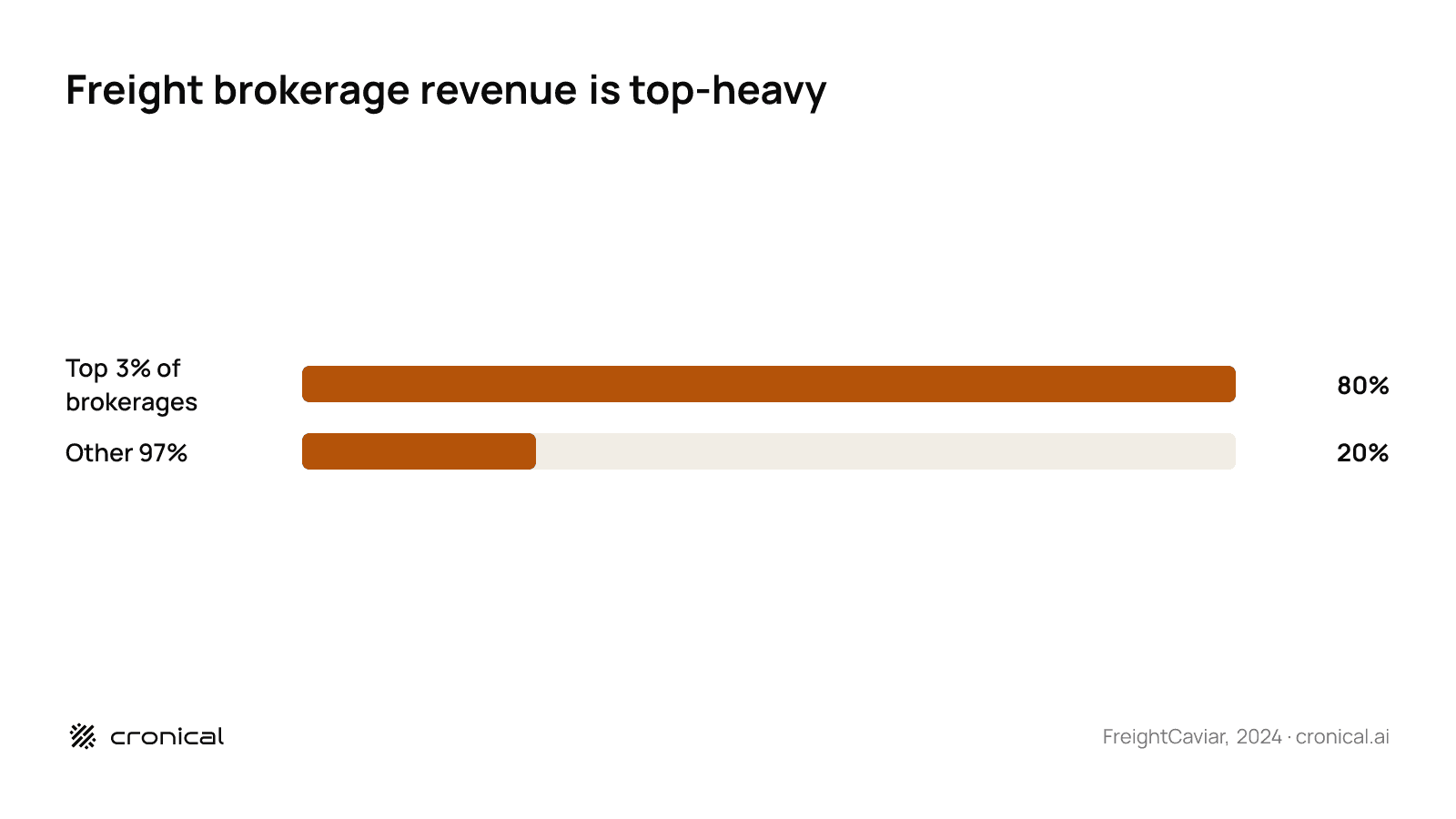
The revenue is stacked at the top. The top 3% of freight brokerages generate 80% of the industry's gross revenue, which leaves the remaining 97% of brokerages competing for a fifth of the money. If you run a small or midsize brokerage, that is the real competitive picture: a long tail of firms fighting over a thin slice, where a few wasted weeks of outreach is the difference between growing and closing.
And plenty are closing. Freight brokerages contracted 8.47% in 2023 and another 7.38% in the first half of 2024, with more than 4,000 shutting down since the 2022 peak. Roughly 30,000 active brokerages remain registered with the FMCSA, and the count keeps drifting down. A shrinking, top-heavy market rewards brokers who win shippers deliberately and keep them, and it punishes the ones who chase volume and churn.
Map the shipping org before you generate a single lead
Here is where most freight brokers leak deals. They find one contact at a shipper, usually a logistics or traffic manager, and treat that person as the account. But a company's freight is rarely awarded by one person. It runs through a group: the logistics or transportation manager who lives with the service, procurement or sourcing who runs the bid, plant or warehouse operations who feel every missed pickup, and a finance sign-off on spend and terms. Each cares about a different risk. Procurement wants the rate. Operations want the dock covered. Finance wants the payment terms. A pitch that lands with one of them can mean nothing to the others.
This is the same structural problem every complex B2B sale has, and it has a name. Brent Adamson, then a distinguished vice president at Gartner and co-author of The Challenger Sale, put it plainly.
The hardest part of B2B solutions isn't selling them, but buying them.
The numbers back it up. B2B buyers spend just 17% of their buying time meeting with all potential suppliers, and only 5% to 6% with any single sales rep, with 27% going to independent online research. Translate that to freight: the shipping org does most of its thinking without you, across several people you have not met. Reaching one of them covers a sliver of the decision.
The group is also getting bigger. The average B2B deal now involves 6.8 decision makers, climbing to 11.2 for deals over $50,000. A midsize shipper awarding a lane package sits squarely in that range. This is the first real act of freight lead generation done right: before you spend a dollar of outreach, map who is on the committee, because that is who you are actually selling to. Shippers, remember, are usually manufacturers and distributors, and their internal buying groups look the same as any other industrial account.
The freight sales cycle, and why single-threading breaks
Freight can feel fast. A spot load books in an hour. But winning a shipper's contract freight is slow, and the length is where single-threaded deals quietly die.
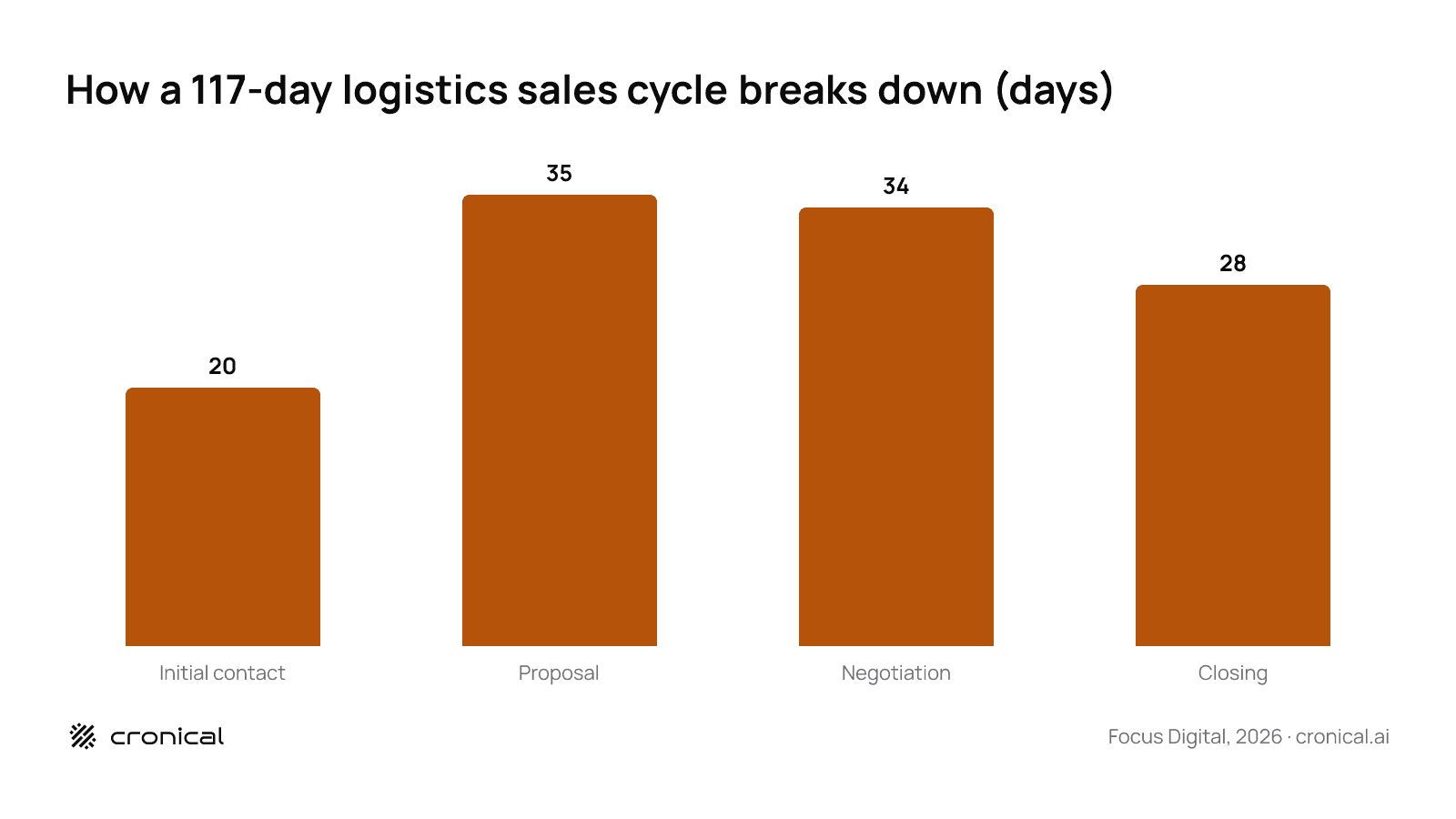
A logistics deal averages about 117 days from first contact to close, split across roughly 20 days to first contact, 35 to proposal, 34 in negotiation, and 28 to close. That is close to the 84-day median across all B2B on the short end, and it stretches well past it for large network bids. Every extra person on the buying group adds time too: each decision maker extends the cycle by an estimated 8 to 15 days.
Now put those two facts together. A deal that takes four months, carried by one contact, is fragile. Over 117 days that single champion can change roles, get pulled onto another project, go quiet for three weeks, or be overruled by a procurement lead you never spoke to. The longer the cycle, the more time there is for your one thread to snap. This is the gap Cronical is built to close: account-first cold outreach that reaches the whole shipping org in parallel instead of betting a long deal on one inbox. That is what account-based outreach means in freight, and you can see how it works if it matches how you sell.
The Routing Guide Ladder: a framework for logistics lead generation
Pull the last three sections together and a method falls out. The market is crowded and top-heavy, the shipper is a committee, and the cycle is long enough to break a single thread. So logistics lead generation has to be account-based, and it has to build toward the one thing that actually grows a shipper relationship: your position in their routing guide. Here is that method as a sequence you can run.
The framework
The Routing Guide Ladder
- 01
Target lanes, not logos
Score shippers by lane fit, mode, and volume where you already have carrier capacity, not by whoever answers the phone. You win the freight you can actually cover, and a short list of coverable accounts beats a long list of names you cannot serve.
- 02
Map the shipping org
Before outreach, identify the logistics or transportation manager, procurement or sourcing, plant or warehouse operations, and the finance sign-off. Each weighs a different risk, so each needs a reason to engage that speaks to theirs, not one generic message blasted at all of them.
- 03
Multi-thread before the bid
Shippers re-bid on 24-to-36-month RFP cycles. Get known across several contacts before the bid opens, so when it does you are invited rather than cold. A relationship built after the RFP drops is already too late to shape it.
- 04
Land a test lane
Get assigned one lane, or backup and spot capacity, to prove service. The first award is rarely the whole book; it is a tryout. Treat it as the audition it is, and over-deliver on the freight you were trusted with.
- 05
Climb the routing guide
After you prove service on one lane, expand to primary status, more lanes, and more shipping locations in the same account. The installed relationship is the cheapest freight you will ever win, and the second award costs a fraction of the first.
The order is the point, which is what makes this a ladder and not a checklist. You cannot map a shipping org before you have chosen the account. You cannot multi-thread before you know who is on the group. You cannot climb before you have landed a first lane. Skip a rung and the deal falls through the gap you left. Run them in sequence and each one sets up the next, until the expansion in the last step sends you back to the top inside a bigger account.
The freight broker's logistics lead generation playbook
The Routing Guide Ladder is the strategy. This is the execution: the concrete moves that fill the top of it and feed the account work underneath.
Start with the list, because a sharper list is the cheapest lever you have. Use load board directories, shipper databases, and public business listings to build a target set, then cut it to the lanes and modes you can genuinely cover. Enrich each account with the named roles inside it, so your reps are not guessing who to call. Good data enrichment turns a raw company list into a mapped account with the logistics manager, the procurement contact, and the operations lead already identified.
Then work the phones with intent, not volume. The reason blind dialing feels hopeless is that it is: without a reason to call and a person to ask for, most dials die in voicemail. The brokers who convert are the ones who improve the input on both ends, the list and the skill.
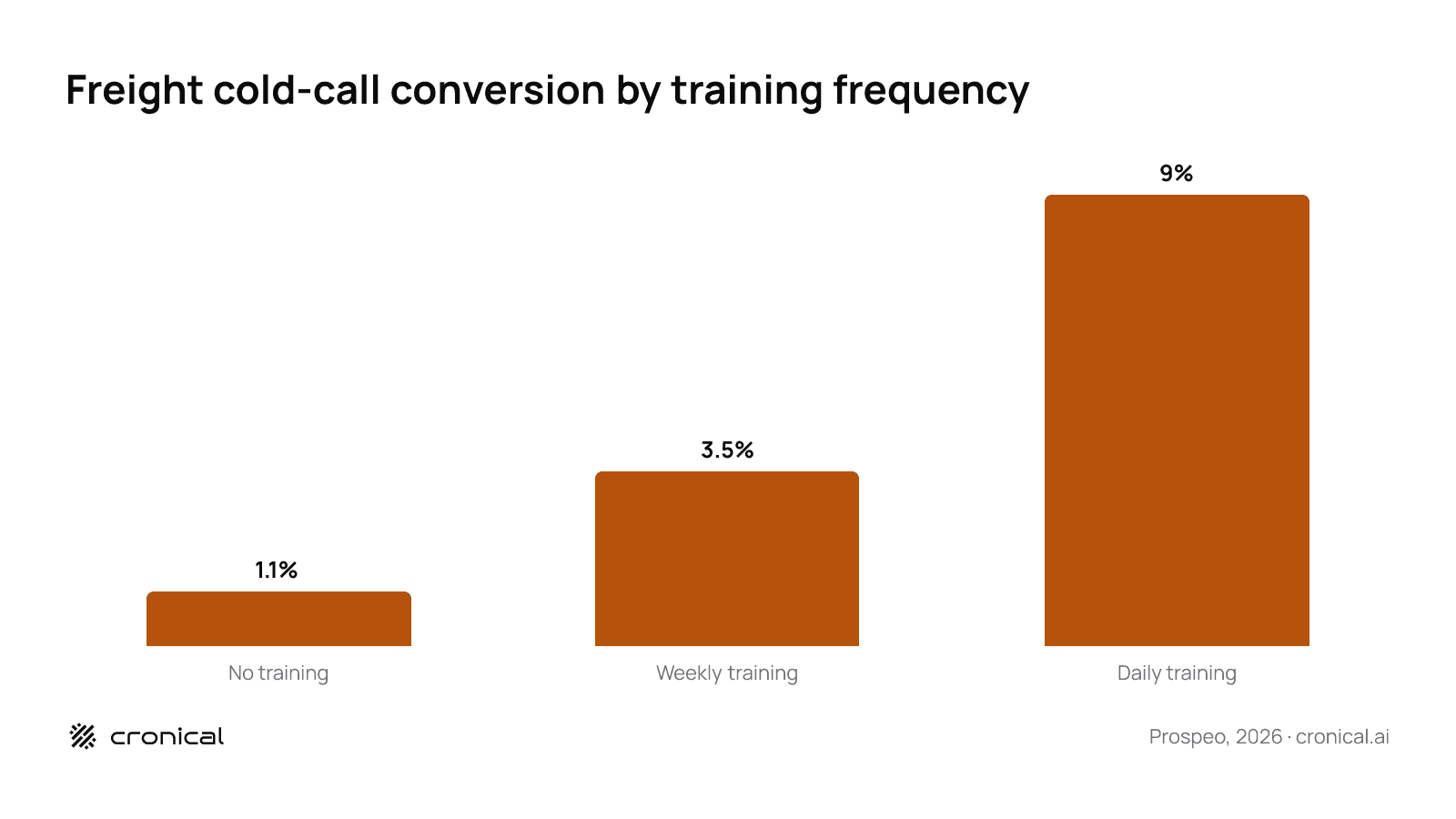
The skill side compounds. An untrained rep converts freight cold calls at about 1.1%, weekly training lifts that to 3.5%, and daily practice to 9%, roughly an eightfold swing from reps alone. Pair that with a list built around coverable lanes and mapped contacts, and the same dial count books far more freight.
The final input is timing: reaching a shipper when they are actually in the market. Kevin Hill, who runs Brush Pass Research and has spent a decade selling into freight brokerages, describes what changes when you can see that signal.
Seeing where and how shippers are actively searching for capacity gives you unmatched intel into their needs.
A signal like a lane going out to bid or a shipper searching for capacity tells you which account to work, not who to invoice. It is the trigger for the ladder, not a finished lead. The follow-up job is still to map the org and multi-thread it.
Inbound marketing for logistics: build the demand engine
Outbound gets you shippers now. Inbound marketing for logistics is what makes the next quarter's outbound cheaper, and it matters more every year as buyers self-educate before they ever talk to a broker. Sixty-one percent of B2B buyers now prefer a rep-free buying experience for as long as they can, which means the broker whose content answers a shipper's question earns trust before the first call.
For a freight broker asking how to market a logistics company, the demand engine is not complicated. Win search for the lanes and modes you serve with pages that answer real shipper questions: capacity in a region, a mode you specialize in, a commodity you handle well. Publish the market reads and rate context a logistics manager actually wants. Stay visible on LinkedIn, where the named roles inside your target accounts already are. None of this replaces the phone. It warms the accounts the phone then works, so your outbound lands on shippers who have already seen your name.
The mistake is treating inbound and outbound as a choice. In freight they are one system: content and search generate awareness and the occasional warm inbound lead, and outbound converts the accounts that awareness reveals. Run only one and you either wait forever for inbound to trickle, or you dial cold against shippers who have never heard of you.
A logistics lead generation checklist
What this means for you
- Build your target list from load board directories and shipper databases, then cut it to the lanes and modes you can actually cover.
- Enrich each target account with the named roles inside it: logistics manager, procurement, operations, and finance, before the first dial.
- Judge trade shows and load boards as account discovery, not as finished leads. A badge scan or a listing names an account to work.
- Multi-thread every target shipper: reach several stakeholders in parallel so a four-month deal does not die when one contact goes quiet.
- Time outreach to real signals, like a lane going to bid or a shipper searching for capacity, and treat the signal as a trigger, not a lead.
- After you land one lane, work the next lane, mode, and location in the same account before chasing a cold new logo.
The bigger picture: a consolidating market rewards account depth
The freight market is thinning out. Thousands of brokerages have closed, the revenue is stacked with the largest firms, and the shippers worth having are courted constantly. In a market like that, the winning move is not more volume. It is more depth per account.
A broker who lands one lane at a shipper and then climbs into three more lanes and two more locations has built something a competitor cannot easily dislodge, because service on real freight beats a cold pitch every time. A broker who wins a lane, single-threads the one contact, and never expands is one reorg away from losing it. The consolidation everyone in freight is worried about is also the opportunity: as weaker brokers exit, their shippers go back into play, and the brokers who work accounts deeply are the ones positioned to catch them.
How Cronical fits logistics leads
Once you decide to work the shipper account instead of the single contact, the bottleneck becomes coverage: reaching enough of the right people inside each target shipper to multi-thread a long deal rather than betting it on one inbox. Cronical runs account-first cold outreach for freight and B2B teams. It works the whole shipping org, from the logistics manager to procurement to operations to the finance sign-off, and optimizes for account penetration rate, the share of target accounts you actually reach, instead of the reply rate of a single contact. If that matches how you sell shippers, see how it works, who it's for, or join the waitlist.
Frequently asked questions
How do freight brokers find shippers?
Through a mix of channels, weighted toward outbound. Most brokers build a target list from load board directories and shipper databases, then reach shippers by cold calling, warm calls and referrals, LinkedIn, and trade shows, while a smaller share of leads arrive inbound through search and content. The strongest approach is to treat every channel as a way to find an account, then map and multi-thread that account rather than working a single contact.
What is the best way to get logistics leads?
There is no single best channel, but there is a best method: target shippers on the lanes and modes you can cover, map the buying group inside each one, and reach several stakeholders before the contract goes to bid. Blind dialing a random list is the least efficient version, since around 80% of freight cold calls hit voicemail. A sharper list and a mapped account make the same activity convert far better.
Can you find freight shippers without cold calling?
Partly. Referrals from current customers, inbound leads from search and content, and warm introductions on LinkedIn all produce shippers without a cold dial, and they convert more easily because trust is already there. But they rarely produce enough volume on their own, especially for a newer brokerage. In practice, inbound warms the accounts and outbound converts them, so most brokers still need some form of proactive outreach.
How do you market a logistics company?
Win search for the lanes, modes, and commodities you serve with pages that answer real shipper questions, publish the market and rate context a logistics manager wants, and stay visible on LinkedIn where your buyers are. That inbound engine builds awareness and the occasional warm lead. It works best paired with disciplined outbound, so your calls land on shippers who already recognize your name.
How long does it take for logistics lead generation to work?
Plan for a runway. A logistics sales cycle averages roughly 117 days from first contact to close, and larger network bids run longer. Inbound channels like SEO also take months to mature. Treat logistics lead generation as a pipeline you build over quarters, working accounts deeply, rather than a campaign you switch on for a week.
Related reading
- Is Cold Outreach Dead? No, But Spray-and-Pray Is
- B2B Buying Committees: How to Win the Whole Account
- Manufacturing Lead Generation: A 2026 Playbook
More guides live in the resources library.