Key takeaways
- Spray-and-pray is what died: high-volume, low-relevance blasting to a single inbox no longer clears the bar buyers set.
- Automation is now a commodity. Sending tools, sequence engines, and LinkedIn automation are rented infrastructure, not an edge.
- Reply rates are falling and fall further the more senior the recipient, so volume alone buys diminishing returns.
- The real differentiator is three things working together: data, the insights an AI extracts from it, and account-level context applied across the committee.
- The metric that proves the motion works is account penetration rate, not reply rate on one contact.
In This Post
- Is cold outreach dead?
- What actually died: spray-and-pray
- Why are cold email response rates dropping?
- Why cold outreach automation stopped being a moat
- What replaced it: data, insights, and account-level context
- The teams still winning compete on account penetration
- The Syringe Test framework
- How to run cold outreach that still works
- Where AI fits without making spam worse
- How Cronical turns cold outreach into account penetration
- FAQ
- Related reading
Is cold outreach dead?
No. Cold outreach is not dead, and the people declaring it dead are usually mistaking one bad version of it for the whole practice. Outbound is a small set of channels for reaching someone who has not raised a hand. There is email, there is the phone, there is social. Writing off any of them because a generic blast stopped working is a category error.
Nothing is dead! I think it is wild to have such a finite number of channels that we can use to reach customers and then proclaim that any one of them is dead because we're not good at it, or it didn't work for us.
That is the right frame. The channel is fine. The execution that most teams default to is what stopped working, and it stopped working for reasons that are measurable. So the useful question is not whether cold outreach is dead. It is which version died, and what the survivors are doing differently.
What actually died: spray-and-pray
The dead thing has a specific shape. It is high volume, low relevance, aimed at one contact, and indifferent to whether that contact or that company has any reason to care. For a while it worked on math alone. Send enough, and a few land. That math has broken, and the inbox is the reason.
Email volume is staggering now. The world sends roughly 376.4 billion emails every day in 2025, and a large share of it is noise. Kaspersky's telemetry found that 47.27% of global email traffic was spam in 2024. An unknown sender with a generic pitch is competing against that wall for a sliver of attention, and the buyer's default response to a generic pitch is not neutral. It is hostile.
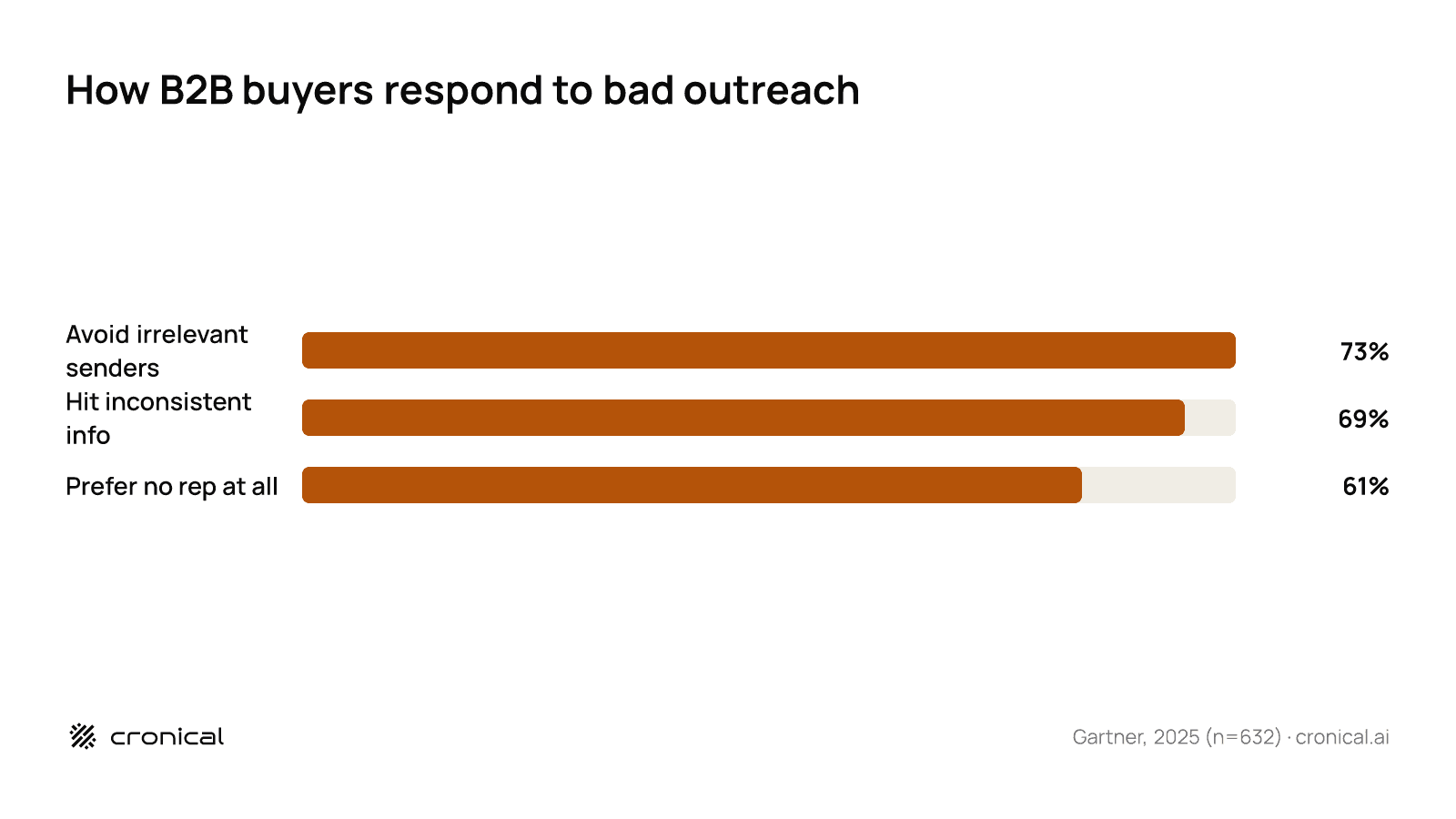
The data is blunt about the damage. Gartner found that 73% of B2B buyers actively avoid suppliers who send irrelevant outreach. Avoid. A bad cold email is not a neutral miss that costs you nothing. It moves the account onto a list you do not want to be on.
Bad prospecting actively damages relationships with potential customers.
That is the death certificate for spray-and-pray. When the channel is saturated and the recipient is primed to treat unknown senders as spam, sending more of the same does not raise your number. It lowers it, and it burns the account while doing so.
Why are cold email response rates dropping?
Response rates are not falling because email broke. They are falling because three things shifted at once.
The first is deliverability. Mailbox providers tightened the rules and started enforcing them. Google now requires bulk senders to keep their spam complaint rate below 0.3%, with 0.1% as the target. Cross that threshold with a sloppy high-volume campaign and your messages stop reaching the inbox at all, which means your reply rate falls before a human ever sees the send.
The second is that the tooling commoditized, so everyone is sending more, and the average quality of what lands dropped. The aggregate result shows up in the benchmarks. Belkins analyzed 16.5 million cold emails and found the B2B reply rate fell from 6.8% in 2023 to 5.8% in 2024, a drop of roughly 15% in a single year. For reference, average cold call success now sits around 2.3% according to Cognism. These are the numbers a generic motion produces.
The third is a penalty you pay for reaching up. The more senior the recipient, the less likely they are to reply to a cold message, because senior people get more of them and have less patience for irrelevance.
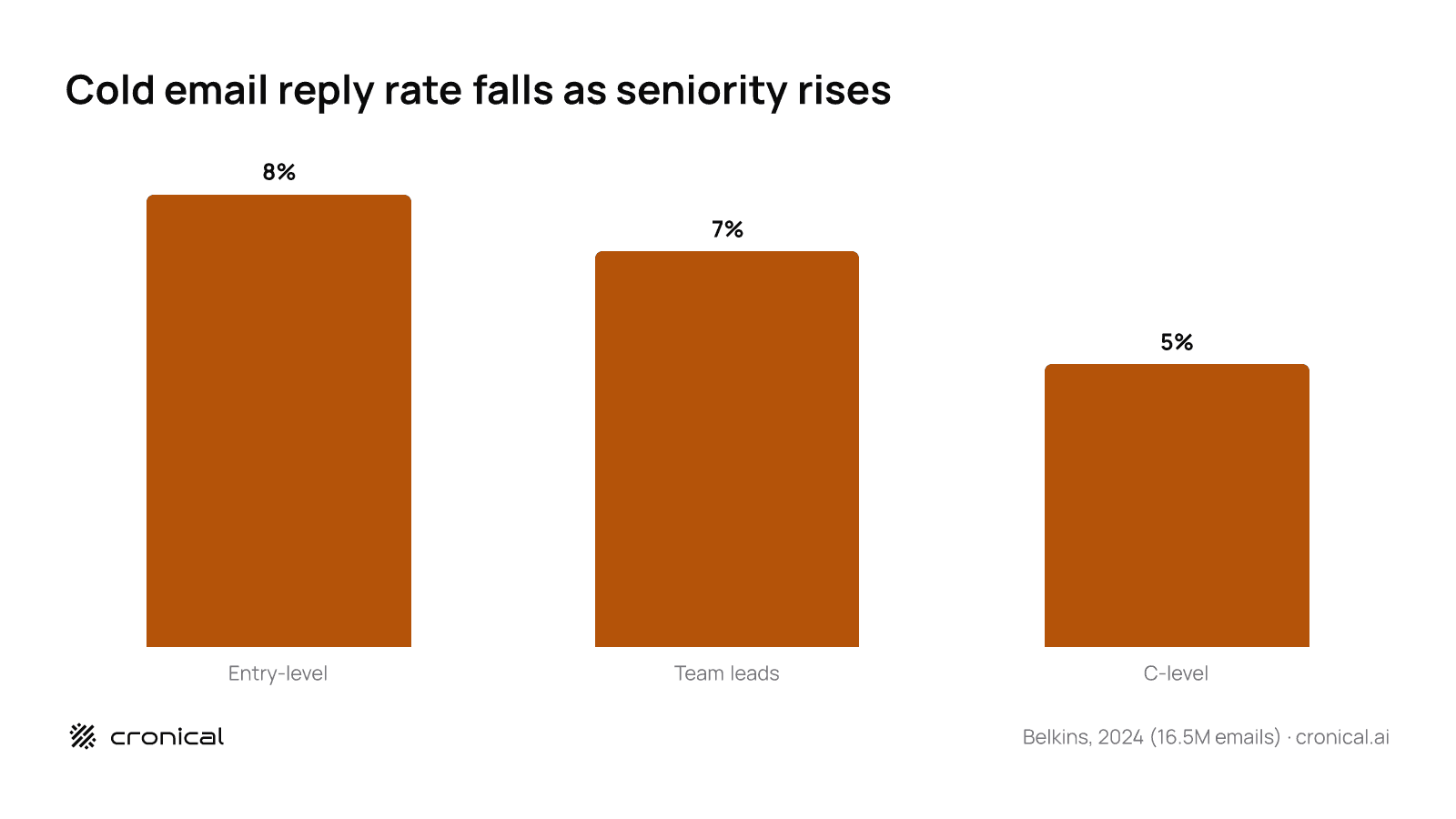
Belkins found entry-level contacts reply around 8%, team leads around 7%, and C-level around 5%. The people who control budget are the hardest to reach with a generic message, which is the worst possible combination if your only lever is volume.
Why cold outreach automation stopped being a moat
Picture a syringe. The syringe is the delivery mechanism: the barrel, the plunger, the needle. It moves something from outside the body to inside it. By itself it does nothing useful. The thing that matters is the serum inside it. A syringe full of saline and a syringe full of a vaccine look identical and behave identically right up to the moment of effect.
Cold outreach automation is the syringe. The sending tool, the sequence engine, the LinkedIn automation, the scheduling and the throttling, all of it is delivery. For a few years owning a good syringe felt like an advantage because not everyone had one. That window closed. The tooling is cheap, abundant, and increasingly AI-assisted: HubSpot found that 47% of sales professionals already use generative AI for outreach and content. When close to half the market can generate and send at the same speed you can, speed is not a moat. It is table stakes that everyone has paid.
So the question is what is in the syringe. And here is where most teams get it wrong: they treat generic data as if it were the serum. Job title, headcount, tech stack, funding stage. That information is real and useful, but anyone can buy it from the same providers you buy it from. Commodity data injected through a commodity syringe is saline. It travels but it does not land.
| The syringe (commodity) | The serum (your edge) | |
|---|---|---|
| What it is | Delivery: sending tools, sequence engines, LinkedIn automation, plus generic enrichment data (title, headcount, tech stack) | Data (the record of what the company actually did), insights (what the AI extracts from it), and context (how those insights apply across the account) |
| Who can get it | Anyone, off the shelf, for a low monthly fee | Only the team that gathers the action data and interprets it for this specific account |
| What it costs | Cheap and falling, commoditized further by AI | Effort to collect, interpret, and apply; not buyable as a list |
| Does it win | No. Everyone has it, so it cancels out | Yes. It is the part the buyer cannot get from a generic sender |
The syringe is delivery plus generic data, and it is a commodity. The serum is data, insights, and account-level context working together.
If your only edge is that you send faster or that you bought the same enrichment fields everyone else bought, you have no edge. The moat moved to the serum.
What replaced spray-and-pray cold outreach: data, insights, and context
The replacement for spray-and-pray is not a clever subject line. It is a different payload entirely, made of three parts that only matter together.
The first part is data: the raw record of what a company actually did and what changed. A new office, a leadership hire, a product launch, a shift in hiring, a public commitment to a new market. Not the static firmographic fields, the actions.
The second part is insights: what an AI extracts and interprets from that data. Raw events are not useful on their own. The insight is the read on what those events mean for this company's priorities right now, and which of its problems just got more urgent.
The third part is context: how those insights get applied across the account. The same interpreted picture of where the company is going, translated into a reason each specific stakeholder should care, in their own terms.
Data plus insights plus context is the serum. Commodity data on its own is not enough; it is the saline. This is also why message quality, not just targeting, moves the number. Backlinko and Pitchbox studied 12 million outreach emails and found that personalized message bodies earn a 32.7% better response rate. Personalization here does not mean a merge field. It means the message reflects something true and current about the account that a generic sender could not know.
The guidance from the analysts who study buyers says the same thing in plainer language.
Instead of offering generic information that buyers can find elsewhere, sellers should offer unique guidance, acting as a sounding board for buyers.
Why contact-level personalization hit a wall
The first wave of "personalization" was contact-level, and it was always commodity data in disguise. Inserting a "first name" merge field and a line about the prospect's job title felt personal, but every other sender had the same fields from the same data providers. Mentioning that someone is "VP of Sales at a 200-person company" tells the buyer you bought a list. It is the saline again: real information, zero edge, because it is available to everyone who pays. Contact-level enrichment hit a wall because it never carried any serum. It was decoration on an empty syringe.
Account-level context: every employee is aligned to one company outcome
The shift that makes the serum scalable is moving from the contact to the account. Here is the founder's thesis, and it is the load-bearing idea: every employee at a company is aligned to one company outcome. The CEO, the CMO, the director of demand gen, and the ops lead are all, in different ways, pointed at the same business result. That means the data and insights you gather about the company stay valid across every person inside it. You do the interpretive work once, at the account level, and it applies to the whole committee.
Contact-level personalization made you start from scratch on every individual. Account-level context lets one well-built read on the company power a dozen role-specific messages. The serum is brewed once and injected many times. That is what makes relevance affordable at scale, and it is the foundation of an account-based go-to-market motion.
The teams still winning compete on account penetration
Once the serum is account-level, the right metric stops being reply rate and becomes account penetration rate: the share of your target accounts where you reached a real conversation across the committee, not a delivered email to one inbox. The reason is structural. B2B purchases are not made by a person. The average B2B buying group runs 6 to 10 decision-makers, according to Gartner. Reach one of them brilliantly and you have still missed most of the room.
It gets harder, because buyers spend very little of their time talking to you at all. Gartner found that B2B buyers spend only 17% of their total purchase time meeting with potential suppliers, and that sliver gets split across every vendor in the running. A single-threaded relationship in that environment is fragile. Your one contact goes quiet, changes jobs, or simply loses an internal argument you were never in the room for, and the deal stalls. Penetration across the committee is what keeps you in the conversation while the group makes up its mind. If you want the full anatomy of who sits on that group and how they decide, the guide to the B2B buying committee covers it, and account penetration is the operating goal of an account-based GTM motion.
The Syringe Test
Before you spend another hour on outreach, run it through a test that separates the delivery from the value. The steps are ordered on purpose: each one depends on the one before it.
Separate delivery from value, then act on it
The Syringe Test
- 01
Separate the syringe from the serum
Audit your outreach and split it in two. The syringe is delivery: the sending tool, the sequence engine, the LinkedIn automation. The serum is three things working together, data (the raw record of what the company did and what changed), insights (what the AI extracts from that data), and context (how those insights apply across the account). Delivery is a commodity anyone can rent, and generic enrichment data is commodity too. If your only edge is sending faster, you have no edge.
- 02
Load account-level context, not contact-level data
Because every employee is aligned to one company outcome, the data and insights you gather on one stakeholder stay valid across the whole account. Generic fields like 'VP of Sales, 200 employees' are commodity data. The company's actual situation, interpreted, is the serum. Build that read once, at the account level.
- 03
Inject across the committee, not into one inbox
Apply that one account-level context to every relevant role on the buying group, with each message fitted to that person's slice of the same company outcome. This is the point where blasting one contact at high volume and real account penetration diverge.
- 04
Measure penetration, not replies
Track account penetration rate: the share of target accounts where you reached a real conversation across the committee, not the reply rate on a single inbox. It is the only metric that still proves the motion works once delivery is effectively free for everyone.
The reason the test is sequenced rather than a menu is that you cannot load account-level context until you have admitted the syringe is commoditized, and you cannot measure penetration honestly until you are injecting across the committee instead of one inbox. Skip a step and the later ones produce nonsense.
How to run cold outreach that still works
Here is the playbook, concrete and in order.
Start by picking the accounts. A focused list of companies that genuinely fit beats a broad list every time, because the serum is expensive to brew and you want to brew it for accounts worth winning. Next, build the account-level context: gather the action data on each company, let the analysis surface the insights, and write down what is actually changing for that business right now. Then multi-thread the committee in a deliberate waterfall, not a simultaneous blast. Reach the senior sponsor first, then the function leaders, then the operators who will live with the decision, each message carrying the same account read translated into their concerns. Keep a human in the loop on the messages that matter, because judgment is still the part the machine should not own. Finally, measure penetration, not sends. Track the share of target accounts where a real conversation is underway across multiple roles.
This is also why the rep-free preference does not mean buyers want silence. Gartner found that 61% of B2B buyers prefer a rep-free buying experience, but that is a verdict on generic, low-value reps, not on relevant guidance. Buyers do not want to be sold the information they can find themselves. They will make time for a sender who tells them something true about their own situation. The mechanics of building that motion are the substance of an account-based GTM playbook.
Where AI fits without making spam worse
The fear is reasonable: more AI means more volume means more spam. That outcome is only inevitable if AI is used as a faster blaster. Used correctly, AI is the opposite of a volume amplifier. It is the context-application layer.
The useful role for AI is to do the interpretive work that does not scale by hand. It reads the action data across an account, extracts the insights, and applies them as role-specific context to each member of the committee. Crucially, a system like this can improve from its own action data over time, learning which reads land and which fall flat, getting sharper at the interpretation rather than just faster at the send. Pair that with a human in the loop on the high-stakes messages, and AI stops being a way to send a thousand generic emails and becomes a way to make one well-understood account legible to a dozen stakeholders. That is the forward-looking version of cold outreach, and it does not make the inbox worse. It makes the small fraction of relevant messages more relevant.
Move from spray-and-pray to account penetration
- Audit your outreach and label every part as delivery (the syringe) or value (data, insights, context).
- Switch your headline metric from reply rate to account penetration rate.
- Map the buying committee for each target account before you write a single message.
- Build account-level context once per account: gather action data, extract insights, write the read.
- Multi-thread the committee in a waterfall, each message carrying the same account read in the recipient's terms.
- Keep a human in the loop on the messages that carry real stakes.
How Cronical turns cold outreach into account penetration
Cronical is built for exactly this shift. It gathers the action data on each target account, uses AI to extract the insights and apply them as role-specific context across the whole buying committee, and runs coordinated email and LinkedIn outreach so your threads reinforce each other instead of colliding. It optimizes for account penetration rate, the share of target companies you actually reached, rather than the reply rate of a single contact, and it keeps a human in the loop on what matters. It is for the founder or lean team that has the account list but not the hours to brew the serum and inject it across every committee by hand. Join the waitlist.
Frequently asked questions
Is cold outreach dead?
No. Cold outreach is not dead. The high-volume, low-relevance version known as spray-and-pray is what stopped working, because inboxes are saturated, deliverability rules tightened, and buyers now actively avoid senders who send irrelevant messages. Relevant outreach to the right account, built on data and account-level context, still works.
Does cold email still work in 2026?
Yes, when it carries real account-level relevance. Generic blasting produces falling reply rates, with B2B cold email replies dropping from 6.8% in 2023 to 5.8% in 2024. Messages that reflect something true and current about the account, applied across the buying committee rather than one inbox, still open conversations.
Why are cold email response rates dropping?
Three reasons at once. Mailbox providers tightened deliverability, with Google requiring bulk senders to keep spam complaints below 0.3%. The sending tools commoditized, so volume rose and average quality fell. And senior recipients, who control budget, reply least to generic messages, around 5% at the C-level versus 8% for entry-level contacts.
What works instead of cold outreach by volume?
Account penetration. Instead of blasting one contact, you build account-level context once per company, then reach the whole buying group of 6 to 10 decision-makers with role-specific messages drawn from the same read. The metric you track is account penetration rate, the share of target accounts where a real conversation is underway across the committee.
Is automation killing cold email?
Automation made cold email worse only because it was used to scale the generic version. The sending tools are a commodity now, so speed is not an advantage. Used as a context-application layer rather than a faster blaster, AI can make outreach more relevant by extracting insights from account data and applying them across the committee, with a human in the loop.