Key takeaways
- Mid-market B2B deals now involve 6 to 10 stakeholders; past roughly $50K it climbs to 11 to 13 or more.
- Buying committees have nearly doubled since 2015, from about 5 people to 8 to 13.
- Single-threaded deals close at around 5%. Reaching five or more stakeholders pushes that to roughly 30%.
- Each committee member weighs a different risk, so one generic message rarely lands with all of them.
- Mapping the committee and tailoring outreach by role is the difference between stalling and closing.
In This Post
- What is a buying committee?
- How big is a B2B buying committee?
- Who sits on a buying committee? The seven roles
- Why single-threaded deals lose
- How to reach the whole committee
- Working the whole account with Cronical
- FAQ
What is a buying committee?
A buying committee, or buying group, is the set of people inside a company who collectively decide on a purchase. Nobody owns the call alone. Budget, security, the people who will actually use the thing, legal, and an executive sponsor all shape it, and any one of them can slow it down or kill it.
The short version
A "yes" from your main contact is not a deal. It is one vote. You need several, usually from people who will never reply to a cold email. This is why "find the decision-maker" is outdated advice. There usually isn't one.
How big is a B2B buying committee?
Bigger than most sequences assume. The baseline for mid-market deals is six to ten stakeholders, and it climbs with deal value and complexity. Independent research consistently lands the average B2B purchase around eleven to thirteen people, with large enterprise technology deals reaching far higher.
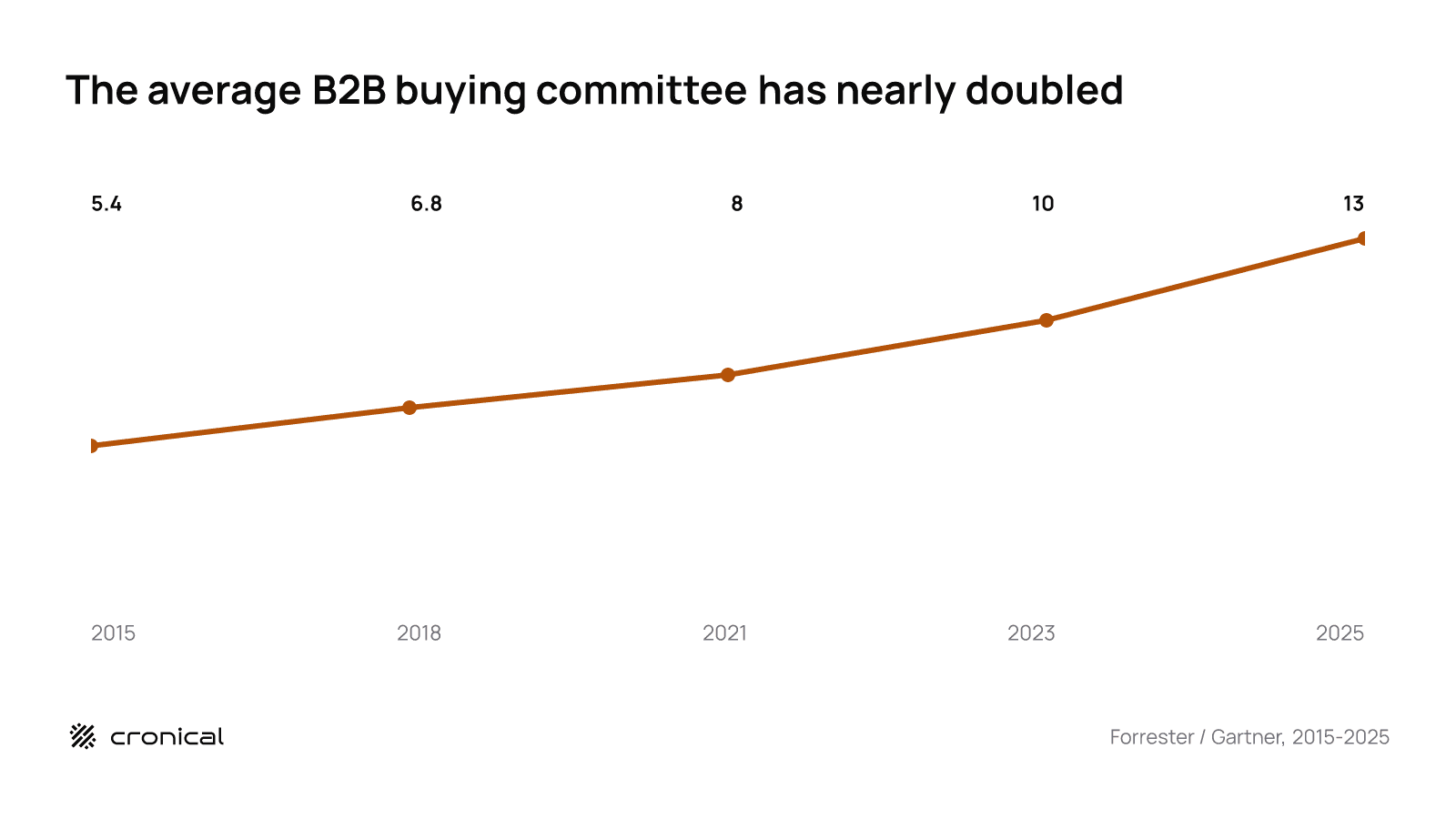
The picture shifts with deal value, so plan your reach against it:
| Deal value | Typical committee size | Average sales cycle |
|---|---|---|
| Under $25K | 3 to 5 stakeholders | 14 to 90 days |
| $25K to $100K | 5 to 9 stakeholders | 60 to 90 days |
| $100K to $250K | 6 to 10 stakeholders | 120 to 210 days |
| $250K and up | 10+ across legal, security, finance, procurement, IT | 180+ days |
Committee size and sales cycle scale with deal value. Figures synthesized from Forrester, Gartner, and 6sense research.
A few patterns worth planning around:
- More people, longer cycles. Committee size correlates directly with cycle length. Every added stakeholder is another alignment loop and another chance to stall.
- Industry swings it hard. Technology purchases are the outlier, often 13 to 25 people. Financial services adds compliance and risk; manufacturing and healthcare cluster lower.
- The trend only goes one way. New functions keep earning a seat: security, data privacy, procurement, AI governance.
A sequence can be structurally undersized
An outreach approach built for a five-person committee in 2018 cannot cover a thirteen-person committee today. If a plan targets only one or two contacts per account, the problem usually isn't the messaging, it's the coverage.
Who sits on a buying committee? The seven roles
You don't really message a committee. You message roles, and each one cares about something different. Send all of them the same email and you sound generic to every one of them.
Map the committee
The seven roles on a B2B buying committee
- 01
Economic buyer
Owns the budget and the final yes. Cares about business outcome and ROI, not features.
- 02
User buyer
Lives in the tool day to day. Cares about workflow and whether it makes their job easier.
- 03
Technical buyer
Vets security, integration, and architecture. Cares about risk, and can veto.
- 04
Champion
Your internal seller. Engage them early; they make the case in the rooms you are not in.
- 05
Influencer
No formal authority but shapes opinion. The domino whose support tips the others.
- 06
Blocker
The skeptic or incumbent loyalist who quietly kills momentum. Surface them early, don't avoid them.
- 07
Approver
Finance, legal, or procurement at the finish line. Late-stage, but able to freeze a closed-won deal.
The mistake isn't failing to know these roles. It's knowing them and still sending all seven the same message.
Why single-threaded deals lose
Here is the case in one number.
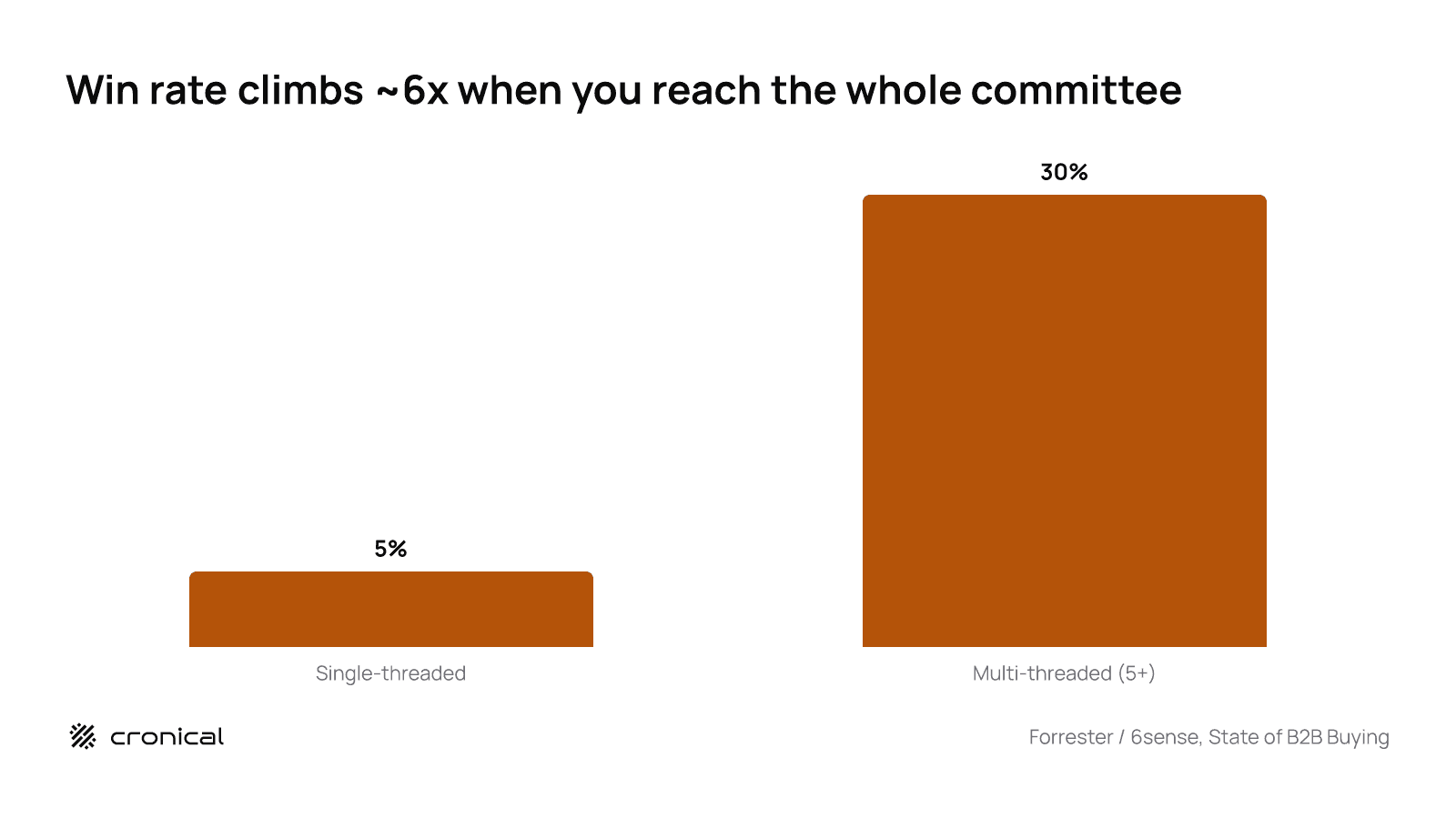
The reason is structural, not motivational. When the whole deal rides on one relationship, it inherits every risk that person carries: they go quiet, they change jobs, they get overruled, or they never had the authority everyone assumed. Working several stakeholders spreads that risk and builds the internal consensus committees now require before they buy.
Roughly 86% of B2B purchases stall at some point in the cycle, and the primary cause is internal complexity on the buyer's side, not vendor performance.
So the deals that survive tend to be the ones where enough of the committee was already aligned.
Mass emailing the buying committee, sending one identical email to everyone, is the fastest way to look automated to an entire account at once.
How to reach the whole committee
Reaching a group of 6 to 13 people is not about sending more email. It is about reaching the right people with the right message, in a way that doesn't read as a blast.
- Different roles need different messages. The economic buyer wants ROI, the technical buyer wants security, the user wants their day made easier. One angle does not fit all of them.
- Use more than one channel. Some stakeholders respond on LinkedIn, others by email. A single-channel approach only reaches part of the group.
- Coordinate your touches. When several threads run into the same account, time them so they reference a shared initiative and reinforce each other, rather than landing as obvious, identical messages.
A practical committee playbook
- Map the committee first: list the roles and the gaps, sized to the deal.
- Tailor the message to each role, not each person.
- Use both LinkedIn and email so you reach people where they actually are.
- Space and sequence touches so threads into one account reinforce, never collide.
- Give your champion material they can use to sell internally.
- Track how much of each committee you have actually reached, and chase the gaps.
Try this
Pull one closed-lost enterprise deal and count how many committee members you ever actually reached. It is almost always one or two. That coverage gap is usually why it died.
Working the whole account with Cronical
Cronical is built for exactly this motion: it runs coordinated LinkedIn and email sequences across an entire buying committee, with role-specific messaging timed so your threads into an account reinforce each other rather than collide, so you work the whole company instead of betting the deal on one contact. Join the waitlist.
FAQ
What is a buying committee?
The group of people inside a company who jointly decide on a purchase, typically the economic buyer, user, technical buyer, champion, influencer, blocker, and approver. No single person owns the decision.
How many people are on a B2B buying committee?
Most mid-market deals involve 6 to 10 stakeholders. The average B2B purchase runs 11 to 13, and large enterprise technology deals can reach 20 or more.
What is the difference between single-threaded and multi-threaded sales?
Single-threaded means a deal depends on one contact. Multi-threaded means you are engaged with several committee members at once. Multi-threaded deals reaching five or more stakeholders close at roughly six times the rate.
How do you reach a whole buying committee without spamming it?
Tailor the message to each role, reach people across both LinkedIn and email, and coordinate the timing so your threads reference a shared initiative and reinforce each other, rather than sending one identical email to everyone.