Key takeaways
- B2B SaaS sales is the work of winning recurring software revenue, where the goal is not closing once but retaining and expanding an account over years.
- There are three motions: product-led (self-serve), sales-led (transactional and enterprise), and hybrid. The right one follows your deal economics, not your preference.
- Sub-$15K deals can't fund a rep and need self-serve. $50K+ deals can't survive self-serve, because they hit procurement, security review, and a buying committee of six to ten people.
- Single-threading is where SaaS deals die. On deals over $50K, working the whole committee lifts win rates by 130%.
- Past roughly $50M ARR, expansion revenue overtakes new logos entirely. Retention and net revenue retention are the scoreboard that says your motion actually works.
In This Post
- What is B2B SaaS sales?
- The three B2B SaaS sales models: PLG, sales-led, and hybrid
- The B2B SaaS sales process, stage by stage
- Matching the motion to the deal: the SaaS Motion Fit framework
- Account-based selling for B2B SaaS
- The metrics that tell you the motion is working
- Land and expand: why retention beats new logos in SaaS
- A B2B SaaS sales checklist
- How Cronical fits B2B SaaS sales
- Frequently asked questions
- Related reading
What is B2B SaaS sales?
B2B SaaS sales is the work of selling subscription software to other businesses, where the buyer pays month after month rather than once. That one fact, recurring revenue, reshapes the entire job. You are not trying to close a sale and move on. You are trying to win an account that keeps paying, grows its spend, and is hard to dislodge.
The cycle is longer than most people expect. Across 939 B2B SaaS companies with stage-level CRM data, the median sales cycle runs 84 days, and cycles have lengthened 22% since 2022. But the median hides everything that matters, because cycle length tracks deal size almost exactly.
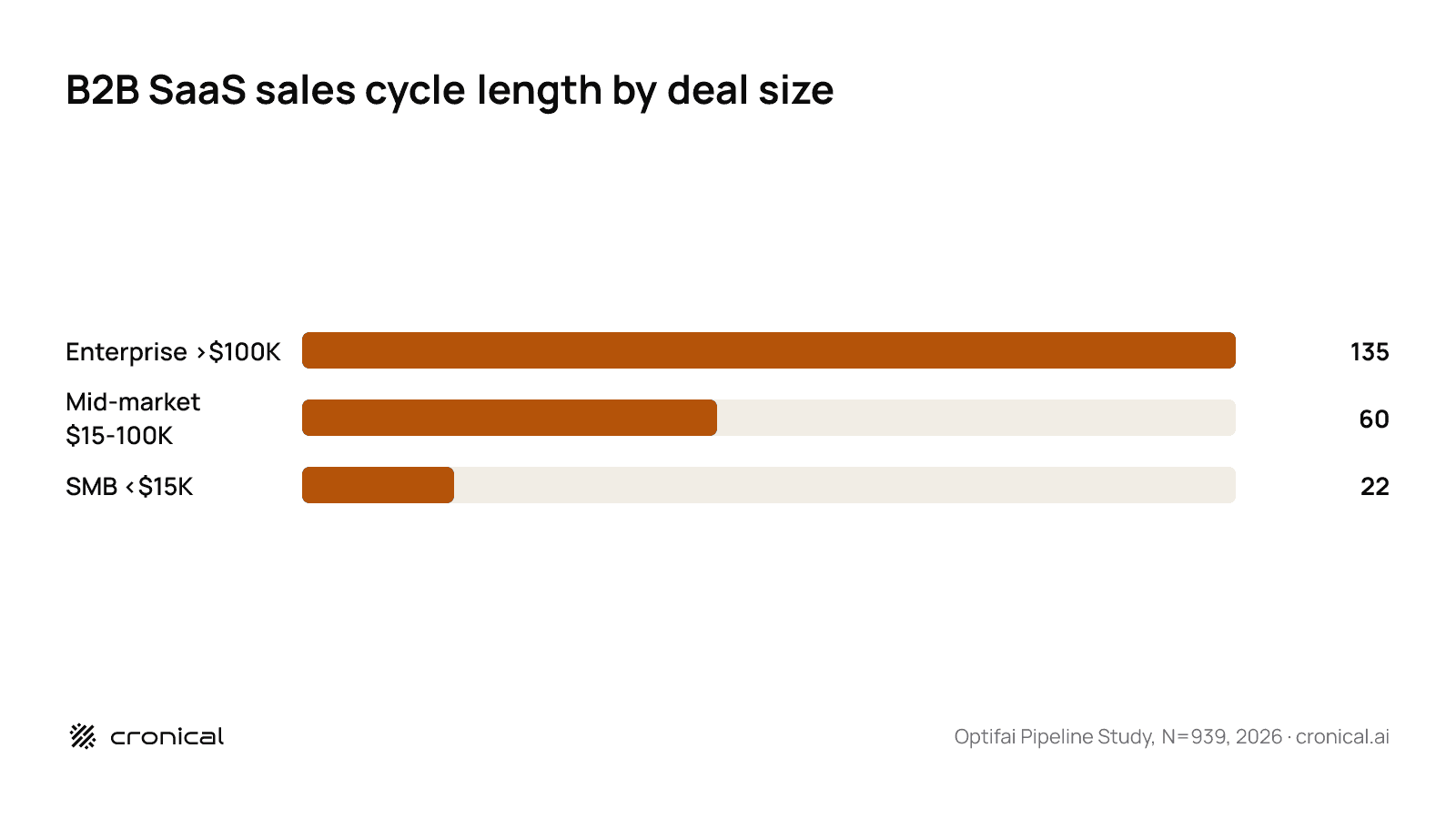
A sub-$15K deal closes in a few weeks; an enterprise deal over $100K takes three to six months or more. I have sold deals that took twelve months to close, and the reason was never the product. It was the buying committee, the holidays, the one stakeholder who went quiet for three weeks. That spread is the single most important thing to internalize about this trade, and it drives every decision that follows.
How SaaS sales differs from one-time software sales
Selling on-prem or one-time software was a closing business. You signed the contract, shipped the license, and went looking for the next logo. Recurring revenue inverts that. The contract is the start of the relationship, not the end of it, because the customer can leave at the next renewal and most of your revenue depends on them not leaving.
So the modern motion is built around two things that did not matter much in a one-time sale: retention, and expansion. A SaaS company that closes well but churns badly is a bucket with a hole in it. That is why the rest of this guide treats new-logo selling as only the first act.
The three B2B SaaS sales models: PLG, sales-led, and hybrid
Every B2B SaaS company runs one of three motions, and the choice is the most consequential one in the whole go-to-market. Get it right and the math compounds. Get it wrong and you either burn margin paying reps to close tiny deals, or you starve big deals of the human attention they need to clear procurement.
The reason the choice is forced, not free, is that cost to acquire a customer has to be paid back out of recurring revenue, and the payback clock runs very differently by segment.
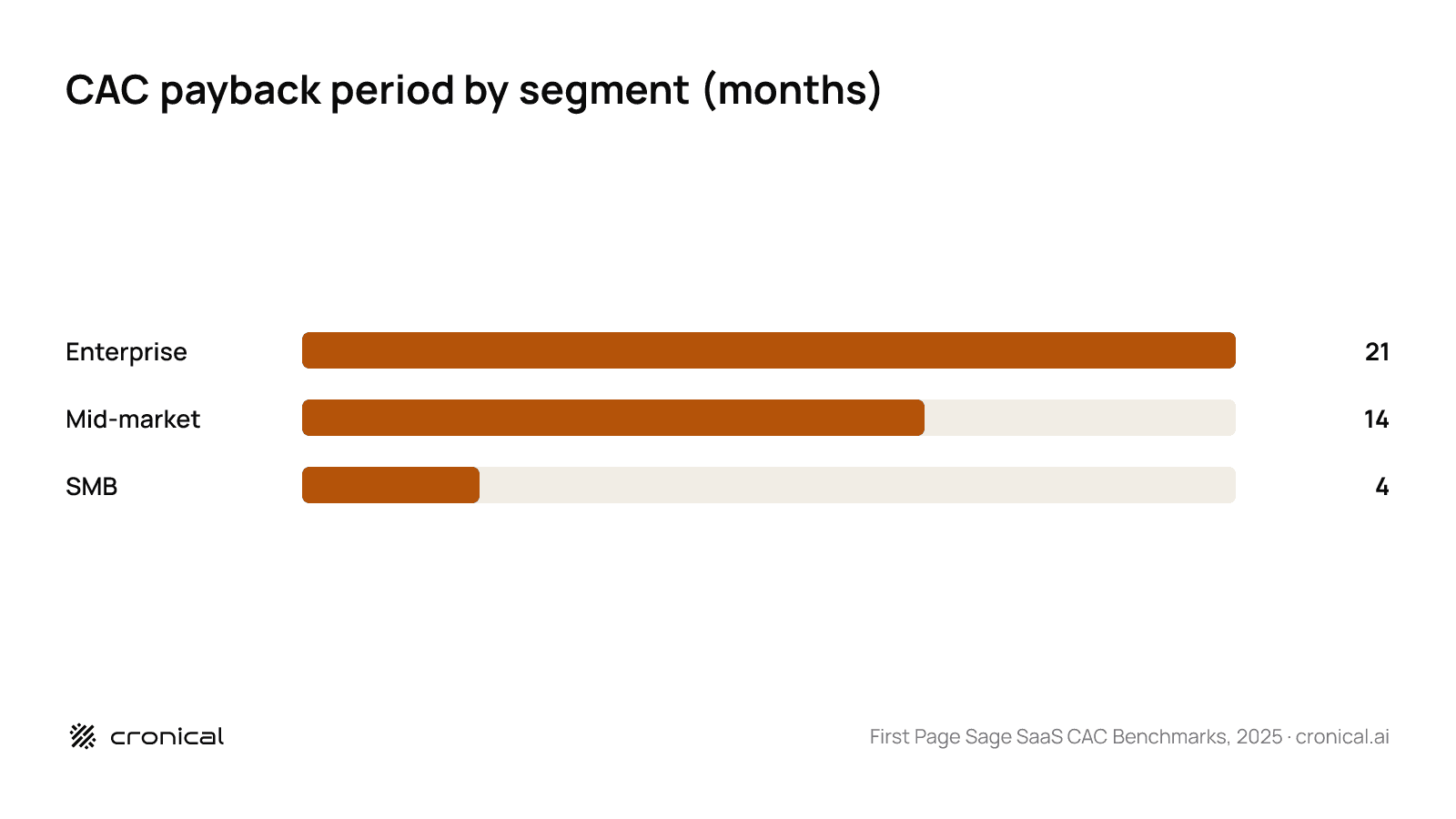
Enterprise SaaS can carry a CAC payback of 21 months because the contract is large and sticky. An SMB product that took that long to pay back its acquisition cost would be insolvent. The motion has to fit that reality.
Product-led growth (self-serve / freemium)
In a product-led motion the product does the selling. The user signs up, hits value on their own, and upgrades without ever talking to a person. It is the right answer when deals are small and volume is high, because nearly 60% of surveyed SaaS companies now run a product-led motion for exactly that reason: a human cannot economically touch a $40-a-month deal.
The trap is believing product-led means sales-free. Wes Bush, who wrote the book that named the category, is blunt about where the free experience has to do real work.
Does your free motion actually have a transformation in it where they can feel they will grow bigger, save time, and do cool stuff? Because if you don't have that, it's literally just, 'Hey, look around, see for yourself, see what you can do in this product.' That's not real value.
Sales-led (transactional and enterprise)
A sales-led motion puts a human on the deal. It splits into two sub-motions that people wrongly treat as one. Transactional sales-led handles mid-market deals fast: one or two stakeholders, a demo, a quote, a close in weeks. Enterprise sales-led handles the big contracts: multiple stakeholders, security questionnaires, procurement, legal, and a cycle measured in months.
The mistake I see most is running the enterprise playbook on a transactional deal. I once chased a client for months whose order value was a measly $10,000 a year. Against the time and effort I poured in, that deal lost money for the company. The fix for the small end of sales-led is speed. For deals below $10,000 we straight up asked prospects to put it on an Amex, on their company card. That single move shaved about a month off the buying process, because it routes around procurement entirely.
Hybrid: product handles the bottom, sales handles the top
Most companies that go upmarket end up hybrid: the product converts the small accounts, and sales chases the large ones. The art is drawing the line at the right ACV and routing each deal to the motion its economics demand. Kyle Poyar, who helped popularize product-led sales at OpenView, frames the hybrid not as a compromise but as a deliberate pairing.
The magic happens when you're pairing the self-serve motion with the human touch, the things that humans are great at doing.
| Product-led | Sales-led (transactional) | Sales-led (enterprise) | |
|---|---|---|---|
| Typical ACV | Under $15K | $15K to $50K | $50K and up |
| Primary buyer | End user, swipes a card | A manager with budget | A committee of six to ten |
| Sales cycle | Days, self-serve | Weeks | Months |
| What closes the deal | The product experience | A demo and a quote | Multi-threaded consensus |
| Where it breaks | Upmarket: no one to clear procurement | Pushed too big: stalls | Run on a small deal: loses money |
The same product can need all three motions at different price points. The buyer and the cycle, not your preference, decide which one applies.
The B2B SaaS sales process, stage by stage
Underneath the motion sits a process. A sales-led SaaS deal moves through roughly six stages, and the modern wrinkle is that the buyer has already done most of the early ones before you hear from them.
The stages run: prospecting and list building, qualification, discovery, demo and evaluation, proposal and procurement, then close. Top of funnel is usually owned by an SDR, who ramps to productivity in about 3.2 months; the deal then moves to an AE, whose ramp has climbed to 5.7 months as deals have gotten more complex.
The reason the early stages have moved to the buyer is that buyers now self-educate. Gartner found 61% of B2B buyers prefer a rep-free buying experience for the parts they can do alone. That does not mean selling disappears. It means the selling moves earlier and wider. The website does the work a junior rep used to do, and the human is reserved for the parts a website cannot handle: the committee, the objection, the negotiation.
Matching the motion to the deal: the SaaS Motion Fit framework
Here is the core claim of this entire guide: in B2B SaaS your motion should be derived from your deal economics, then layered with account-based execution once the math points to sales-led. Most teams pick a motion by taste, copy a competitor, or default to whatever the founder is comfortable with. The economics do not care about any of that.
I evaluate every motion decision against the same four steps, in order. The order is the point. You cannot thread a committee before the economics say to run sales-led, and you cannot engineer expansion before you have landed anything to expand.
Derive the motion from the math, in this order
The SaaS Motion Fit
- 01
Read the economics
Start from ACV, CAC payback, and cycle length. A sub-$15K self-serve deal cannot fund a human rep. A $50K-plus deal cannot survive being left to self-serve, because it will hit procurement and a buying committee that no product tour can clear.
- 02
Pick the motion the math allows
Product-led below the line where deals are too small for a person. Sales-led above it where contracts can pay back a rep. Hybrid across a mixed ACV range, with the product converting the bottom and humans chasing the top.
- 03
Thread the committee
On every sales-led deal, map the six-to-ten buyers and work several of them at once. Single-threading is where SaaS deals die. This step does not exist for a pure self-serve deal, which is exactly why it sits third.
- 04
Engineer expansion
Instrument net revenue retention and land-and-expand so the motion compounds after the first close. You cannot do this before you land, which is why it is last, and why it is the step most teams never reach.
Run any go-to-market plan through The SaaS Motion Fit and the failures announce themselves. A rep assigned to a $40-a-month product is step one ignored. An enterprise deal left to a free trial is step two ignored. A six-figure deal riding on one champion is step three ignored. And a company obsessed with new logos while its existing accounts quietly stagnate is step four ignored.
Account-based selling for B2B SaaS
Once the math points to sales-led, the unit of the deal stops being a contact and becomes the account. This is the heart of account-based GTM, and it is where most SaaS teams underperform, because they keep selling to one person inside a company that decides as a group.
The reframe is simple and I say it to every founder who will listen: the contact is not the company. I have had a contact at a huge multinational tell me, do not message anyone else here. I respect the request, but I do not believe it is within one person's authority to gate an entire organization from a conversation. A company is many threads across teams and geographies. Your job as a seller is to map those threads, not to accept one person's map of them.
The buying committee and multi-threading
A modern SaaS purchase is decided by a group, and the group has been growing for a decade.
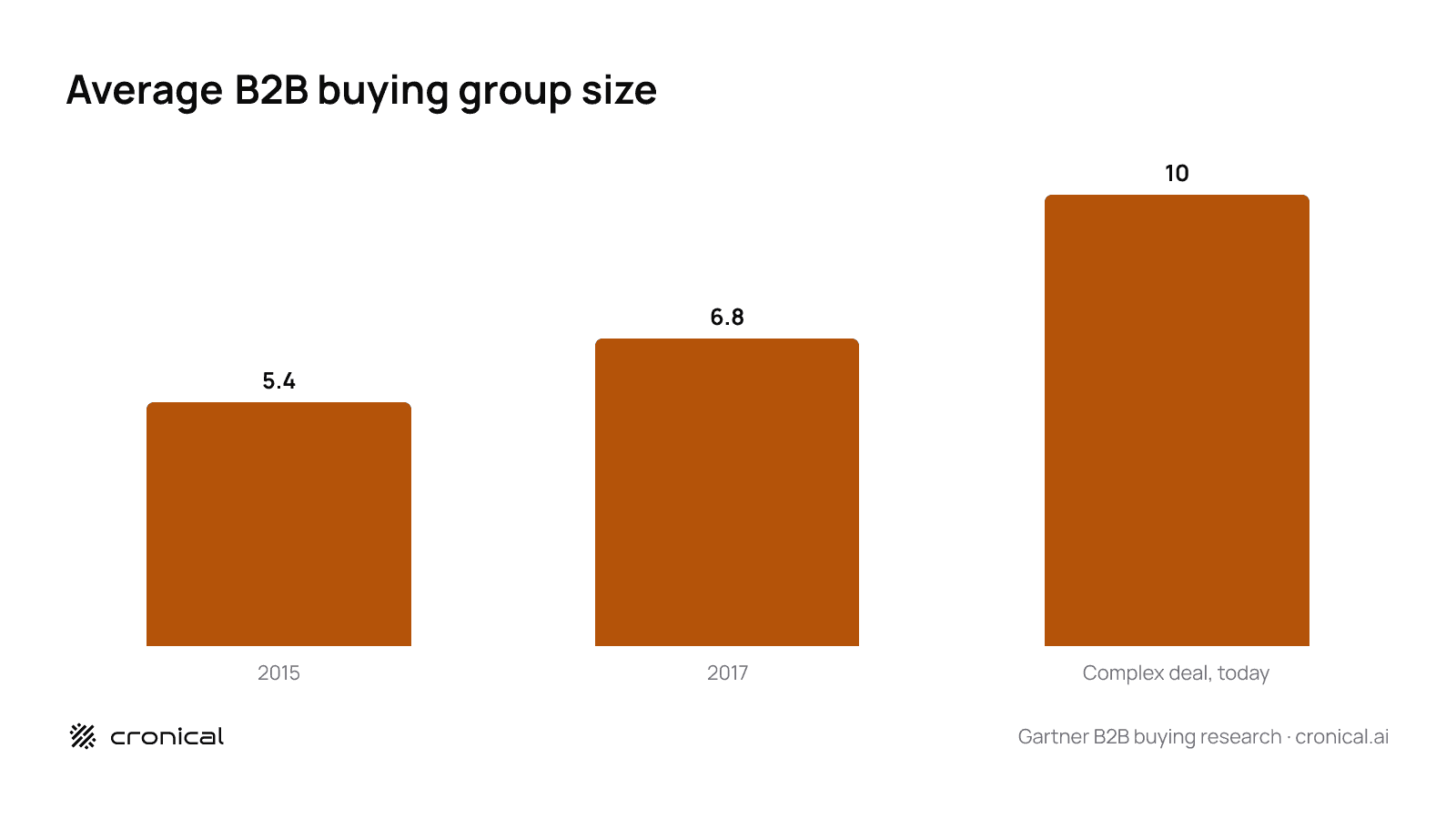
Gartner puts a complex B2B purchase at six to ten decision-makers, each arriving with four or five pieces of independently gathered information. In my experience the real number of people who touch the deal can run far higher, up to twenty on a sprawling enterprise account, and many of them are not buyers at all. They are blockers whose blessing you still need. Getting a group of friends to agree on dinner is hard enough. Coordinating twenty near-strangers to hand you a contract is the real reason enterprise cycles balloon. Compare that to a consumer sale, which is a committee of one, maybe two if a spouse is involved, and those two are tightly aligned. That gap is the whole difference between B2B and B2C.
The defense against a sprawling buying committee is to multi-thread, and the data on it is hard to argue with.
Gong analyzed 1.8 million opportunities and found multi-threading lifts win rates 130% on deals over $50K, with closed-won deals carrying twice the buyer contacts of closed-lost ones. I learned this the expensive way. In my early days, before I understood any of it, I pitched one mildly excited contact who was maybe 70% sold and replied once every few weeks. I put all my eggs in that one basket. The deal died when he went quiet, and no one else in the account had ever heard of me.
The move that changed my win rate was building swell. Even people with no buying power but real influence, call them person A, person B, person F, create momentum once they are bought in. It is very hard for anyone inside a company to say no to a crowd of colleagues that already has momentum. I have won deals where the economic buyer was lukewarm because the champions carried it. So get written feedback from the people who like the product, show it to the next person, and build the wave. Multi-threading is not best-practice filler. It is insurance against the one contact who disappears.
The metrics that tell you the motion is working
Metrics in SaaS are not a report card you file. They are the live signal that tells you whether your motion matches your economics, and they are where most "b2b saas marketing strategies" content goes vague. Four numbers carry most of the weight.
CAC payback is how many months of recurring revenue it takes to earn back the cost of acquiring a customer; the 21-month enterprise figure above is only survivable because enterprise contracts are large and retain well. LTV to CAC is the ratio of a customer's lifetime value to acquisition cost, and 3:1 is the widely cited floor for a healthy business. Win rate is the share of qualified deals you close; HubSpot's 2024 research put the average at 21%, so closing one in five qualified deals is roughly par. And net revenue retention, covered next, is the one that separates durable SaaS companies from leaky ones.
If you read these numbers together, they tell you the truth about your motion. A long payback with low retention means you picked a motion your economics cannot fund. A short payback with strong retention means the fit is right and you should pour fuel on it.
Land and expand: why retention beats new logos in SaaS
New logos feel good. Closing a new client is like making a new friend, and I have spent most of my career as a new-business person, so I understand the pull completely. But a company that lives on new logos and leaks existing ones is not building durable value, and it is very hard to sell. Buyers of the company, and your own board, look at retention and expansion first.
The economics make the case on their own. Expansion revenue, new business that comes from an already happy client, grows as a share of the total as you scale, until it overtakes new logos entirely.
High Alpha's data shows expansion revenue climbing from 23% of total at small scale to surpassing new-customer revenue once a company passes $50M ARR. The metric that tracks this is net revenue retention, and Bessemer's widely used scale puts 100% NRR at Good, 110% at Better, and 120% or more at Best. SaaS Capital's benchmarks show the link to deal size directly: companies with ACV between $25,000 and $50,000 post a median NRR of 102%, with the top quartile at 111%. Higher-priced, stickier accounts retain and expand better.
Expansion is also the cleanest payoff from multi-threading. If you have a deal in one department, one geography, or one team, you ask for referrals and expand across the rest of the account. Kyle Poyar puts the priority plainly.
Your install base is your most immediate opportunity, especially if there aren't as many new purchases happening.
The goal was never one contact, or even one deal. It is the whole account: every department, every team, every geography you can reach. That is why account-based execution and expansion are the same discipline pointed at two different moments in the relationship.
A B2B SaaS sales checklist
Before you commit to a SaaS sales motion
- Calculate ACV, CAC payback, and median cycle length per segment before choosing a motion.
- Put deals below your rep-funding line on a self-serve path; ask sub-$10K buyers to pay by card to skip procurement.
- Reserve human selling for the deals whose contract value can pay back a rep within your retention window.
- On every sales-led deal over $50K, map the six-to-ten-person committee and work at least three threads.
- Collect written feedback from champions and show it to the next stakeholder to build momentum across the account.
- Instrument net revenue retention and expansion, and treat them as the real scoreboard, not new-logo count.
How Cronical fits B2B SaaS sales
Once your math points to a sales-led motion, the bottleneck is account coverage: reaching enough of the right people inside each target company to multi-thread a deal instead of betting it on one contact. Cronical runs account-first outreach for B2B SaaS teams. It works the whole company, from VP to director to the ops lead to the champion, and optimizes for account penetration rate, the share of target companies you actually reach, rather than the reply rate of a single inbox. If that maps to how you sell, see how it works, who it's for, or join the waitlist.
Frequently asked questions
What is B2B SaaS sales?
B2B SaaS sales is the process of selling subscription software to other businesses, where revenue recurs rather than landing once. Because the customer can leave at renewal, the goal is not just to close but to retain and expand the account, which makes retention and net revenue retention central to how the motion is built and measured.
What are the main B2B SaaS sales models?
There are three: product-led growth, where the product sells itself through self-serve and freemium; sales-led, which splits into fast transactional deals and longer enterprise deals run by reps; and hybrid, where the product converts small accounts and sales chases large ones. The right model follows your deal economics, specifically ACV, CAC payback, and cycle length.
How long is a B2B SaaS sales cycle?
The median is about 84 days, but it tracks deal size closely. SMB deals under $15K close in roughly two to four weeks, mid-market deals in one to three months, and enterprise deals over $100K take three to six months or longer, mostly because more stakeholders have to sign off.
How do you sell to a B2B SaaS buying committee?
You multi-thread. A complex SaaS purchase involves six to ten decision-makers, so working a single contact leaves the deal half-covered. Map the committee, build relationships with several stakeholders including influencers without formal power, and gather written feedback to build momentum that is hard for any one person to override. Gong's data shows multi-threading lifts win rates 130% on deals over $50K.
What metrics matter most in B2B SaaS sales?
CAC payback, LTV to CAC, win rate, and net revenue retention. Together they tell you whether your motion matches your economics. A long payback with weak retention signals a motion your business cannot fund, while a short payback with NRR above 100% signals a fit worth scaling.
Related reading
- Account-Based GTM: Framework, Benefits, and the Execution Gap
- B2B Buying Committees: How to Win the Whole Account
- Is Cold Outreach Dead? No, But Spray-and-Pray Is
More guides live in the resources library.