Key takeaways
- MSP lead generation fails when it waits for referrals. The average MSP books roughly one qualified lead a month, because most owners run no strategic outreach at all.
- Channels are not equal. A referral lead costs about $25; a trade-show lead runs around $840. The whole IT-services category averages roughly $501 per lead, so how you spend matters more than how much.
- The MSP sale is a switch, not an impulse buy. Contracts run 12 to 36 months and the sales cycle runs 90 to 180 days, because several people each have to sign off.
- An SMB does not buy managed IT through one contact. The owner, the finance lead, and the internal IT person or office manager each carry a different fear, and one message rarely lands with all three.
- Treat the account, not the contact, as the unit of the deal. Pick accounts on a live trigger, map the committee, multi-thread it, then expand across their locations and referrals.
In This Post
- What MSP lead generation actually is
- The MSP market is crowded, and everyone feels it
- What an MSP lead really costs: channels ranked by cost per lead
- The MSP sales cycle, and why it drags
- Map the SMB buying committee before you generate a single lead
- The Managed-Account Loop: a framework for MSP lead generation
- The MSP lead generation playbook, step by step
- Account-based outreach for MSPs: reach the whole company
- An MSP lead generation checklist
- The bigger picture: a crowded market rewards coverage
- How Cronical fits MSP lead generation
- Frequently asked questions
- Related reading
What MSP lead generation actually is
MSP lead generation is the work of getting small and mid-sized businesses to consider handing you their IT, and to enter a real conversation about switching. The phrase sounds like ordinary B2B lead gen. It is not, because the thing you are selling is a multi-year operational dependency, and almost nobody buys it on a whim or through a single contact.
Start with the honest baseline for the industry. Most MSPs do not generate leads at all. They wait for them. Robin Robins, founder of Technology Marketing Toolkit and the best-known marketing trainer in the channel, describes the default posture bluntly.
They're relying on referrals. They get referrals if a referral happens to blow their way. They're not doing any sort of strategic outreach.
That is the gap the rest of this guide is about. Referrals are wonderful and you should never turn one away, but a business that only gets fed when a referral happens to arrive has no control over its own pipeline. Demand for managed services is not the problem. Nearly 90% of small and mid-sized businesses already use or are considering an MSP, so the buyers exist. The constraint is reach, and reach is something you build on purpose.
Why lead gen for IT services is harder than ordinary B2B
Three things make managed IT harder to sell than a typical product. The buyer is usually already served, so you are asking them to fire an incumbent, not fill an empty seat. The commitment is long and operational, so the decision carries switching risk that a software trial never does. And the sign-off is shared, because handing over IT touches the owner, the money, and whoever currently keeps the lights on. Every one of those traits points the same way. You cannot win a managed-services deal by charming a single contact, because a single contact cannot say yes on their own.
The MSP market is crowded, and everyone feels it
The reason lead generation has become the industry's sharpest pain is simple. The market grew, and it drew a crowd. The US managed-services market alone is projected to rise from about $69.55 billion in 2025 to $116.25 billion by 2030, a 10.82% annual growth rate. Globally, managed services is heading from roughly $350 billion in 2024 to more than $1 trillion by 2033. Rising money brings more providers chasing the same SMBs, and the providers feel it.
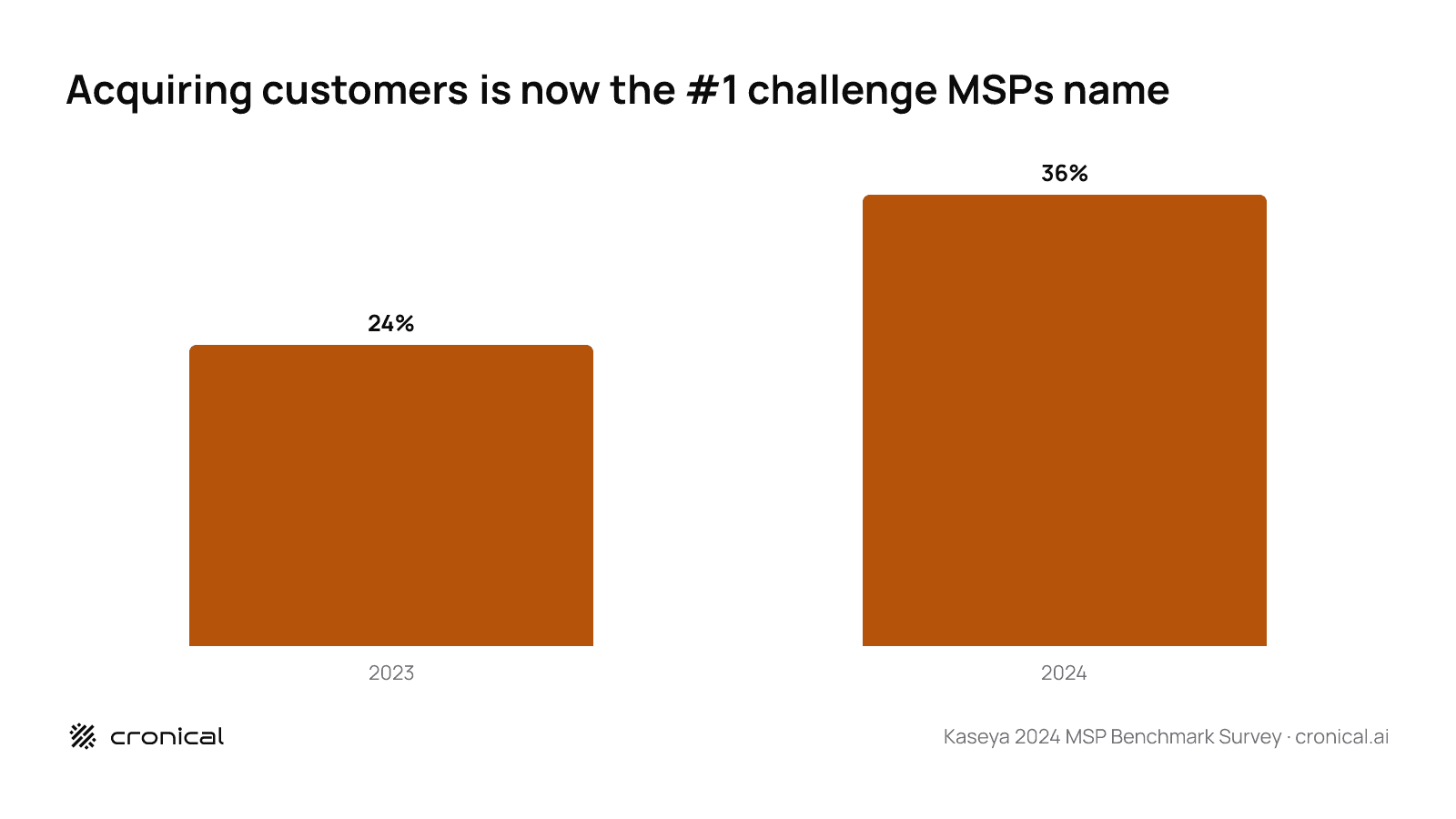
Acquiring more customers is now the single biggest challenge MSPs name, and the pressure is climbing fast. The share of MSPs choosing it as their top concern rose from 24% in 2023 to 36% in 2024. In the same research, 100% of MSPs reported operating in a highly competitive regional market. Everybody is fishing the same pond, and the ones without a system are going hungry.
Here is what the shortage of a system actually looks like on the ground. Robins cited a poll that put a hard number on it, and the number is grim.
One lead a month is not a market problem. It is a method problem. When the Kaseya survey asked executives what blocks new-customer acquisition, they did not name demand or pricing. They named the lack of a dedicated sales representative as their chief barrier, while technicians named the rising competition. The technical work is handled. The going-and-getting is not.
What an MSP lead really costs: channels ranked by cost per lead
Most MSP marketing advice lists the same channels and stops there: SEO, cold email, cold calling, LinkedIn, referrals, events. Almost none of it tells you what a lead from each one actually costs, which is the number that should drive your budget. The spread is enormous.
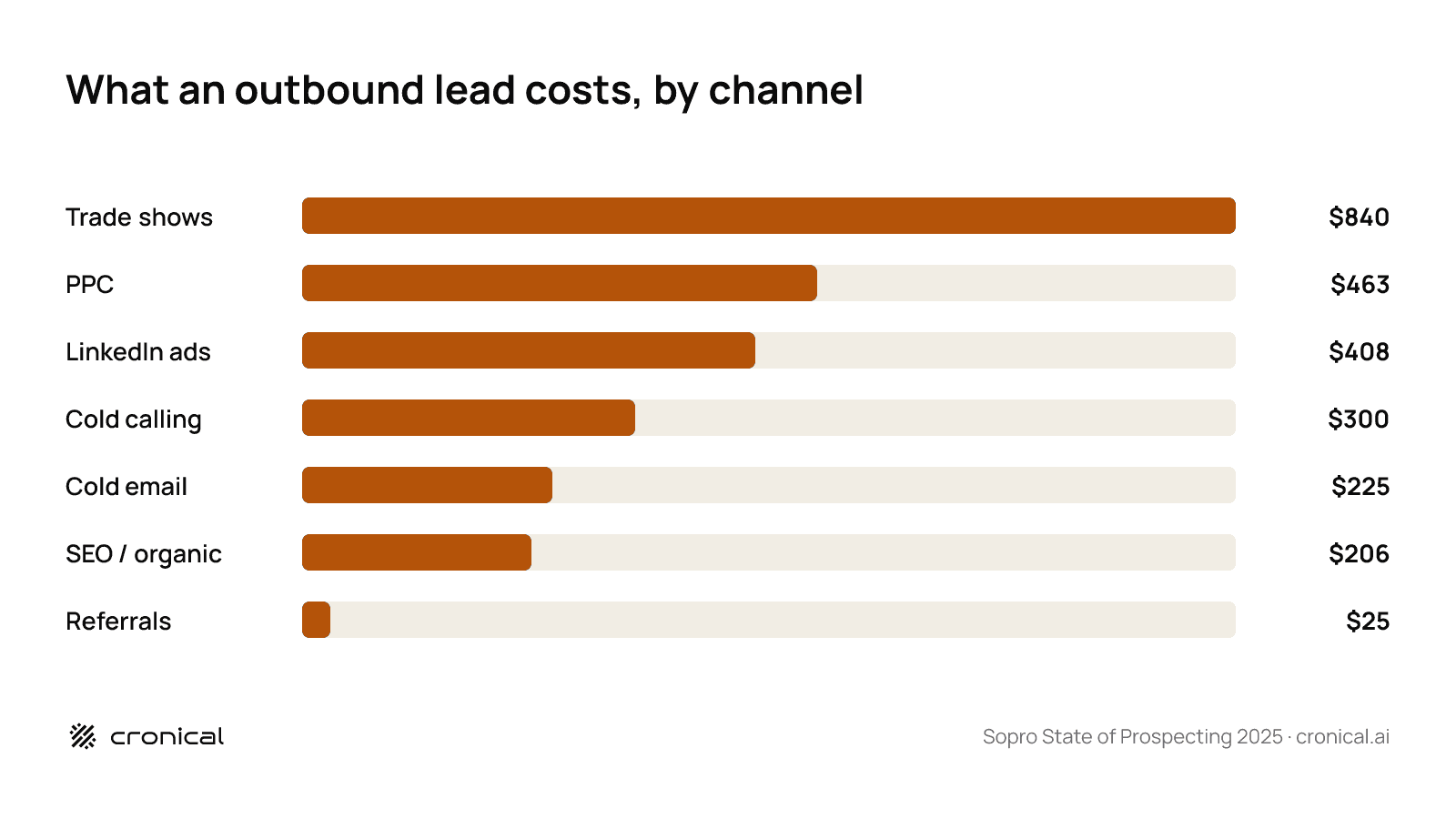
A referral costs about $25 per lead, while a trade-show lead runs around $840, more than thirty times the price. Cold email sits near $225, cold calling near $300, and paid LinkedIn near $408. Across the whole category, IT and managed services average roughly $501 per lead, higher than most B2B sectors because the buyers are hard to reach and slow to switch. Read that ranking and the obvious move looks like pouring everything into referrals. That move is half right and half a trap, which the table below explains.
| Channel | Cost per lead | Buyer intent | What it takes to convert |
|---|---|---|---|
| Referrals | ~$25 | High: a trusted party vouched for you | Low, but you cannot control the volume |
| SEO / organic | ~$206 | High: they searched for the problem | Slow to build, cheap to run once ranked |
| Cold email | ~$225 | You create the intent | Needs targeting and multi-threading |
| Cold calling | ~$300 | You create the intent | High effort, strong for reaching owners |
| LinkedIn ads | ~$408 | Medium: role-targeted, not in-market | Good for committee reach, not cheap |
| Trade shows | ~$840 | Low per badge, high as a signal | High: a scan is not a lead yet |
The trap is treating referrals as a growth strategy just because they are cheap. A referral is the lowest-cost lead you will ever get and the one you have the least control over, since you cannot decide how many arrive this quarter. That is exactly why the one-lead-a-month MSPs are stuck: their cheapest channel is also their only channel, and it does not scale on command. The disciplined read is to keep every referral, then use the channels you do control, cold email, calling, and search, to manufacture the intent that referrals leave to chance.
The MSP sales cycle, and why it drags
Before you spend a dollar generating leads, understand the clock you are on. An MSP contract is not a quick sale. Handing over IT is a 12 to 36 month commitment, and the sales cycle typically runs 90 to 180 days from first real conversation to signature. A prospect who is happy with their current provider will not switch this week no matter how good your pitch is. They switch when a trigger forces the question: a breach, an outage, a contract renewal, a compliance deadline, a growth spurt that breaks their setup.
That long cycle is the structural reason single-threading fails in managed services. A deal carried by one contact over four to six months is fragile. In that window your one champion can change jobs, get reassigned, go quiet for three weeks, or be overruled by someone you never spoke to. The longer the cycle, the more time there is for your single thread to snap. A long MSP cycle does not make account-based outreach a nice-to-have. It makes it the only motion that survives contact with reality.
Map the SMB buying committee before you generate a single lead
If the decision is shared, the first real act of MSP lead generation is mapping who shares it. That is what a B2B buying committee means in practice, and even in a small business it is rarely one person. Gartner puts a complex B2B purchase at six to ten decision makers, each arriving with four or five pieces of independently gathered information. An SMB IT switch is smaller than an enterprise deal, but the shape holds: the owner or CEO who owns the risk and the money, the finance lead who owns the contract and the budget cycle, and the internal IT person or office manager who either feels threatened by you or relieved to offload the grunt work.
Robins teaches exactly this dynamic for co-managed IT, and her warning is the whole case for multi-threading in one paragraph.
When you're selling co-managed IT, you've got a CEO, a CFO, and you've got an IT manager. If you market just to the CEO and you leave out the IT manager, then what happens is the CEO might pass the letter down to that IT person and they feel threatened.
Read that and the reason one-contact outreach stalls becomes obvious. Reach only the owner and the internal IT person feels cut out and blocks you. Reach only the IT person and they gatekeep you away from the owner who signs. Each stakeholder weighs a different risk. The owner fears downtime and liability, finance fears the spend and the contract length, and the internal tech fears for their job. A message that reassures one of them can spook another. You have to reach several of them, on purpose, with a reason each of them cares about.
The Managed-Account Loop: a framework for MSP lead generation
Pull the last four sections together and a method falls out. In managed services, where the cycle is long, the trigger is everything, and the sign-off is shared, lead generation has to be account-based or it leaks. You pick accounts on a live trigger, penetrate the committee, then expand across the rest of the account and its network. Here is that method as a sequence you can run.
The framework
The Managed-Account Loop
- 01
Target on the switching trigger, not just firmographics
Score SMBs on a live or imminent trigger: a breach or outage, an incumbent contract nearing renewal, headcount growth, or a compliance mandate like HIPAA or CMMC. Managed IT is a switching decision, so the trigger, not the logo, is what makes an account workable right now.
- 02
Map the committee
Before outreach, identify the owner or CEO, the finance lead, and the internal IT person or office manager. Each runs their own evaluation and fears a different thing, so each needs a reason to engage that speaks to their risk, not one message blasted at all three.
- 03
Multi-thread with role-specific reasons
Reach several stakeholders in parallel, each with the risk they own: security and liability to the owner, spend and contract terms to finance, offloaded grunt work to the internal tech. A 90 to 180 day switch carried by one contact dies when that contact goes quiet or gets overruled.
- 04
Nurture across the renewal window
The trigger is often months out, so stay present with proof until the switching window opens: response-time SLAs, security posture, named references. This is the step generic playbooks skip, and it is where long-cycle MSP deals are actually won.
- 05
Land, then expand the book
After the first site or department signs, work the client's other locations, sister companies, and referral network. MSP economics are recurring revenue, so the cheapest next contract is the one deeper inside an account you already earned.
The order is what makes this a loop and not a checklist. You cannot map a committee before you have chosen the account. You cannot multi-thread before you know who is on the committee. You cannot expand before you have landed. Skip a step and the deal leaks out the gap you left. Run them in sequence and each one feeds the next, then the expansion in step five sends you back to step one inside a larger account.
The MSP lead generation playbook, step by step
The Managed-Account Loop is the strategy. This is the execution: the concrete moves that fill the top of it and feed the committee work below it. Good MSP marketing starts where the buyer starts, then carries the account all the way to signature.
One reason there is room to win is that most MSPs are still not doing this. Look at how the industry actually acquires clients today.
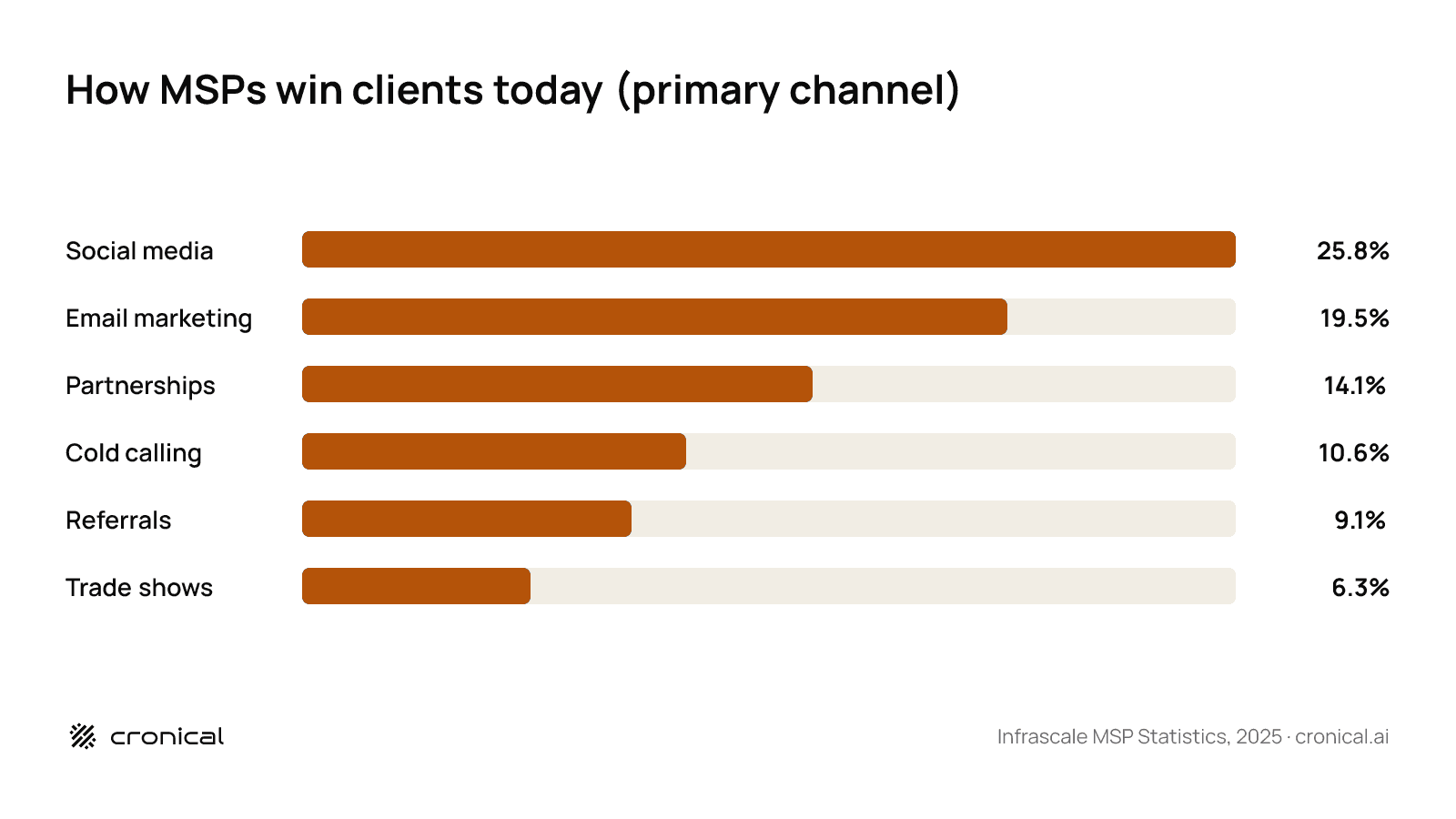
The channels MSPs lean on are led by social media at 25.8%, email marketing at 19.5%, and partnerships at 14.1%, with cold calling at 10.6% and referrals at 9.1%. Notice what is thin: deliberate outbound. Most of that activity is passive presence, a LinkedIn page and a newsletter, not targeted outreach to named accounts. The MSPs that build a real system are a minority, which is why the market rewards them. The good news is the intent is shifting: 49% of MSPs say they are starting or improving their marketing, and 53% are focused on increasing sales and expanding their client roster.
Build the MSP marketing engine buyers find first
An SMB owner who suspects their current IT is failing them starts by searching. Win that search with content that answers the questions they actually type: what a managed-services agreement should include, what good response times look like, how to tell if their setup is a security risk. This is your cheapest owned channel after referrals, and it does the early-stage selling while the buyer self-educates. If your site cannot answer a nervous office manager's question at 11pm, a competitor's will.
Pick a vertical, win it, then widen
Trying to sell to every SMB is how MSPs blend into the crowd. Pick one or two verticals where you already have reference clients and real proof, a handful of dental practices, law firms, or manufacturers, and become the obvious specialist there. Vertical proof makes every message sharper and every reference more persuasive, and it gives you a defensible reason to reach out cold. Once you own one niche, the next is cheaper to enter.
Turn triggers into multi-threaded follow-up
Most MSP outreach is a single templated email to a single info@ address. Replace it with trigger-based outreach to the mapped committee. When an account hits a renewal window or a public security incident, that is your opening: reach the owner, the finance lead, and the internal tech in parallel, each with the angle they care about. The channel is not the point. The coverage is.
Account-based outreach for MSPs: reach the whole company
This is where most MSP lead generation quietly underperforms. A lead comes in, a rep works that one contact through a four-month cycle, and the deal rests entirely on whether that one person carries it. On a shared decision over a long cycle, that is a bet against the odds.
A real approach starts from account-based GTM: pick the account, then reach the people in it in parallel. The reframe that earns it is the one the data keeps pointing at. The contact is not the company. A 40-person business is not one inbox, and an IT switch is not one signature. The unit of the deal is the account and its committee, so working one contact leaves a multi-month decision half-covered.
There is a second reason account-based outreach fits this moment. Plenty of MSPs have concluded that "cold outreach is dead," usually after blasting one generic template at a scraped list and hearing nothing back. That version of cold outreach is dead. The version that reaches the right several people inside a right-fit account, on a real trigger, with a reason each of them cares about, still works, and in a market this crowded it is one of the few motions that reliably does.
Operationally, account-based outreach for MSPs comes down to three habits. Select accounts by fit and trigger, not by whoever happened to fill in a form. Map the committee before you write the first message, so each person gets a relevant reason to engage. Then expand after the first win, because the same client usually has more sites, more staff to cover, and a referral network you have now earned the right to ask.
An MSP lead generation checklist
What this means for you
- Rank your channels by real cost per lead, then keep referrals but stop treating them as your growth plan, since you cannot control the volume.
- Build search content that answers the exact questions a nervous SMB owner types, your cheapest owned lead source after referrals.
- Pick one or two verticals where you have proof, and become the obvious specialist before widening.
- Define right-fit accounts by a live trigger: renewal window, breach, outage, growth, or a compliance deadline.
- Map each target account's committee, the owner, the finance lead, and the internal IT person or office manager, before first outreach.
- Multi-thread every account in parallel so the deal does not die when one contact goes quiet, then expand into their other sites and referrals after the first win.
The bigger picture: a crowded market rewards coverage
Two facts are colliding in favor of MSPs who get this right. Demand is strong and rising, with nearly nine in ten SMBs already using or weighing an MSP and the market on track to more than double this decade. At the same time, most providers still run on passive referrals and a LinkedIn page, which is why one lead a month is so common.
That gap is the opportunity. When the whole field waits for referrals to blow their way, the few who pick accounts deliberately, show up in search, and multi-thread the committee quietly take share. The window is open precisely because adoption of a real system is so uneven. You do not need a better mousetrap than every competitor. You need to be the one that actually goes and gets the account while the rest wait for the phone to ring.
How Cronical fits MSP lead generation
Once you decide to work the account instead of the contact, the bottleneck becomes coverage: reaching enough of the right people inside each target business to multi-thread a long deal rather than betting it on one inbox. Cronical runs account-first cold outreach for MSP and B2B teams. It works the whole company, from the owner to the finance lead to the internal IT contact, and optimizes for account penetration rate, the share of your target accounts you actually reach, instead of the reply rate of a single contact. If that matches how you sell, see how it works, who it's for, or join the waitlist.
Frequently asked questions
How do MSPs get new clients?
The MSPs with predictable growth combine three things: search and content that reach owners who are self-educating, targeted outbound to accounts that hit a switching trigger, and referrals they earn from existing clients. The ones stuck at roughly one lead a month rely on referrals alone, which they cannot control. The fix is to add strategic outreach to named accounts on top of the referral flow, not to replace it.
How much does an MSP lead cost?
It depends heavily on the channel. A referral costs around $25, SEO around $206, cold email around $225, cold calling around $300, and a trade-show lead about $840. Across IT and managed services, the average lands near $501 per lead. The cheapest channels leave volume to chance, so the practical answer is to pay for the channels you can control while keeping every free referral.
How long is the MSP sales cycle?
Plan for 90 to 180 days from first real conversation to signature, because you are usually asking a business to switch from an incumbent under a 12 to 36 month contract. Buyers move when a trigger forces the question, so the job is to be present and multi-threaded when their switching window opens, not to rush a happy prospect.
Is cold calling or cold email still worth it for MSPs?
Yes, when they target named accounts and reach the whole committee rather than one address. Generic blasts to a scraped list are what people mean when they say cold outreach is dead. Trigger-based outreach to the owner, finance, and internal IT of a right-fit account, with a reason each cares about, still books meetings and is one of the few channels you fully control.
Should an MSP hire a marketing agency or do it in-house?
An MSP marketing agency or MSP marketing services can be worth it for search, content production, and paid channels, especially if you have no dedicated marketer, which most MSPs admit is their biggest gap. The account-based outreach itself, mapping committees and multi-threading triggers, is best kept close to the sales conversation, whether that is you, an internal rep, or a tightly briefed partner.
Related reading
- Account-Based GTM: Framework, Benefits, and the Execution Gap
- B2B Buying Committees: How to Win the Whole Account
- Is Cold Outreach Dead? No, But Spray-and-Pray Is
- Manufacturing Lead Generation: A 2026 Playbook
More guides live in the resources library.